
Back to blog
Wellness
How to Interpret a Pharmacogenetic Report
9 min read
Ajolote Azul Team
pharmacogenetic report
metabolizer phenotype
CPIC guidelines
medication genetics
PGx test
To interpret a pharmacogenetic report, locate the medications you use, check which gene was analyzed and which phenotype it assigns you (for example, poor, normal, or rapid metabolizer), and read each recommendation as guidance for your doctor, not as a prescription. The same dose does not produce the same response in every person. Some people metabolize a medication quickly, others process it slowly, and others may have a response different from the one expected. Interpreting a pharmacogenetic report turns that genetic information into better questions for a more precise clinical conversation.
Pharmacogenetics studies how certain DNA variants can influence the way the body absorbs, metabolizes, or responds to medications (1). It does not replace a medical assessment, it does not confirm diagnoses, and it does not by itself indicate which treatment you should take. Its value is in adding a layer of personal information your doctor can consider alongside your clinical history, symptoms, other medications, kidney and liver function, age, and treatment goals.
What a pharmacogenetic report answers
A pharmacogenetic report does not say whether a medication is "good" or "bad" for you. Its reading is more specific: it identifies genetic variants associated with the activity of enzymes, transporters, or receptors involved in the response to particular drugs.
In practical terms, the report can help anticipate whether, for certain medications, your body might process a compound more slowly than usual, at the expected rate, or faster than usual. It can also flag gene–drug combinations worth reviewing with a professional before starting, adjusting, or continuing a treatment.
This is especially useful if you take several medications, if you have had unexpected responses to previous treatments, or if you want to arrive better prepared for a visit with your doctor or specialist. Genetics is one piece of the puzzle, not the whole puzzle.
How to interpret a pharmacogenetic report step by step
The first rule is to read the report with context. A genetic result can be technically correct and still not require any immediate action. Relevance depends on whether you currently use the medication analyzed, whether you might need it in the future, and on your particular clinical conditions.
1. Locate the medication and its therapeutic area
Start by looking for the medications you use today and those you have used before. Many reports organize results by therapeutic area, such as cardiovascular health, pain management, mental health, gastroenterology, or medications used in various clinical procedures.
Not every drug in the same category has the same relationship with a gene. That is why it is worth reading the specific name of the medication, rather than assuming that an observation about one compound applies to every similar treatment.
If you do not recognize a medication, you do not need to research it on your own or draw conclusions. Mark the section to discuss at a future visit. The report can also be useful as a preventive reference so a doctor has genetic information available when evaluating treatment options later.
2. Understand which gene was analyzed
Genes included in pharmacogenetics usually code for enzymes that help transform medications. Some of the best known belong to families such as CYP, but there are also genes related to transporters, receptors, or immune mechanisms. If you want concrete examples, read which genes affect medications.
The gene name, on its own, is not a clinical verdict. Its function makes sense when it is connected to the medication analyzed. For example, a variant may change the activity of an enzyme responsible for processing one specific drug, while it has no relevance for other medications that follow different metabolic routes.
A good report should clearly show the relationship among gene, variant, and medication. This structure avoids broad interpretations such as "my liver works slowly" or "every medication will affect me differently," statements that do not follow from a pharmacogenetic result.
3. Read the phenotype before focusing on the genotype
The genotype describes the genetic variants detected. The phenotype translates those variants into a more practical functional estimate, for example: poor, intermediate, normal, rapid, or ultrarapid metabolizer, terms standardized by the CPIC consortium (2).
For most people, the phenotype is the most useful part of the first reading because it communicates how a metabolic pathway might behave with a given medication. Even so, terms such as "poor" or "rapid" do not automatically mean you should receive a lower or higher dose.
A poor metabolizer might maintain higher concentrations of certain medications for longer, but that interpretation changes depending on the drug, the dose, how often it is taken, and other clinical factors. A rapid metabolizer does not mean a medication "does not work" either. It only indicates that the professional should weigh that information in the proper context.
4. Tell an informative recommendation apart from a medical decision
Reports often classify the relevance of a gene–drug interaction with phrases such as "consider an alternative," "monitor response," "possible adjustment," or "no genetic action identified." These expressions guide a clinical conversation, but they are not instructions to change a prescription.
Never stop, start, or change the dose of a medication based on a genetic report without medical direction. It is also essential to mention supplements, over-the-counter medications, and treatments prescribed by other specialists. Some can inhibit or speed metabolic enzymes and alter the response you see, regardless of your genetics.
Pharmacogenetics can indicate that a pathway deserves attention. The doctor decides whether that signal changes anything in your case.
Why two people with the same result can receive different guidance
Genetics stays stable throughout life, but the response to a medication can change. Liver or kidney function, pregnancy, body weight, smoking, diet, other illnesses, and interactions between medications can modify the concentration or the effect of a drug.
The treatment goal matters too. A medication may need a different assessment when it is used for a short time than when it is taken long term. That is why a pharmacogenetic report does not replace clinical tests, symptom follow-up, or medical evaluation.
This is one reason to avoid absolute interpretations. The report is more useful when it is brought into an informed conversation, not when it becomes a fixed label for how your body "works."
What to bring to your interpretation visit
A specialized visit helps move from a technical document to informed decisions. Before the session, prepare an up-to-date list of your medications, doses, schedules, supplements, and any reactions or responses that caught your attention. If you remember the names of treatments you used before, include them even if you no longer take them.
It also helps to write down your questions. For example: does this result matter for any of my current medications? Is there anything my specialist should know? What clinical data are still missing to assess this recommendation? Concrete questions make the conversation more useful and keep the report from being interpreted out of context.
At Ajolote Azul, the PGx pharmacogenetic test analyzes 51 genes related to more than 200 medications and includes a 60-minute consultation to review the results clearly. It costs $9,800 MXN (see pricing and what is included). The sample is collected with a buccal swab from home, and the report can be delivered with a Spanish translation available, so you have an understandable basis before you talk with your medical team.
Signs that a result deserves priority attention
Not every finding requires the same urgency. It is advisable to review the report with your doctor soon if it identifies a relevant interaction with a medication you currently take, if you are about to start a new treatment, or if you use several medications at the same time.
It is also worth sharing it with professionals involved in your care, especially when a new specialist does not know your full medication history. Bringing a digital copy of the report can make the conversation more precise, but remember that only the treating professional can integrate that information into an individual recommendation.
Turn the report into a tool for informed health decisions
A well-interpreted pharmacogenetic report is not meant to create alarm or promise certainty. It is meant to give you language, context, and data so you can take an active part in your health decisions. The question is not only "which variant do I have?" but "when is this information relevant, and with whom should I review it?"
Keep your report, store it with your medication history, and bring it to relevant clinical conversations. Knowing your genetics does not replace medical judgment: it enriches it with a personal perspective that can stay with you for years.
Frequently asked questions
What does it mean to be a poor metabolizer in a pharmacogenetic report?
It means that, for a specific enzyme, your variants suggest lower activity than usual. With certain medications that can keep the drug in the body longer, but only your doctor can decide whether anything changes in your treatment.
Can I change my dose based on my result?
No. The report guides the conversation with your doctor, but you should never start, stop, or adjust a medication on your own. Your doctor integrates the result with your clinical history and your other medications.
Does my pharmacogenetic report last forever?
Your genes do not change, so the genetic result remains valid over the years. What does change is your health and the medications you use, which is why it is worth reviewing the report again with your doctor when you start a new treatment.
What are the report recommendations based on?
Quality reports classify medications according to guidelines such as those from CPIC, the DPWG, and the FDA, which review the evidence on each gene–drug pair.
References
- MedlinePlus Genetics (in Spanish). What is pharmacogenomics?
- Caudle KE, Dunnenberger HM, Freimuth RR, et al. Standardizing terms for clinical pharmacogenetic test results: consensus terms from the Clinical Pharmacogenetics Implementation Consortium (CPIC). Genet Med. 2017;19(2):215-223. PubMed 27441996
- Clinical Pharmacogenetics Implementation Consortium (CPIC). Published guidelines
- U.S. Food and Drug Administration. Table of Pharmacogenetic Associations
Educational information; it does not diagnose or replace a medical consultation. Any change in medication or dose is always decided by your treating physician.
A
Ajolote Azul Team
Specialist in wellness, nutrition and holistic health. Passionate about sharing science-based knowledge to improve quality of life.
Keep Reading
Related Articles
Discover more content on this topic that might interest you
Wellness
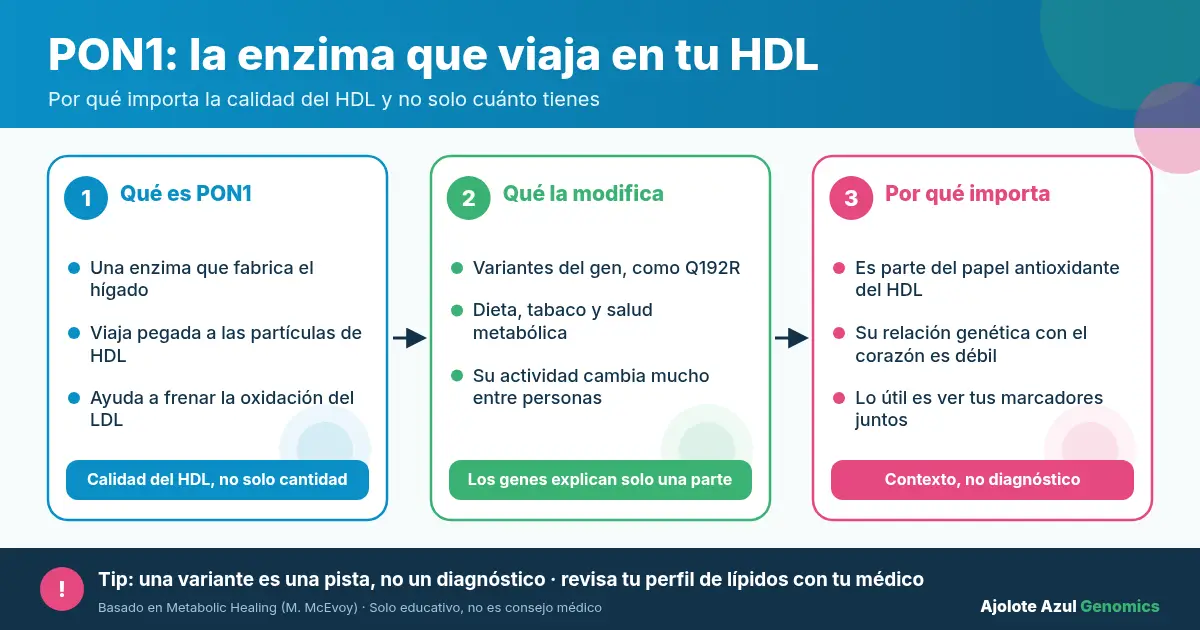
PON1 Gene: Function, HDL, and the Q192R Variant
What does the PON1 gene do? How it relates to paraoxonase, HDL cholesterol, and the Q192R variant—what the evidence shows and its limits.
7 min readRead more
Wellness
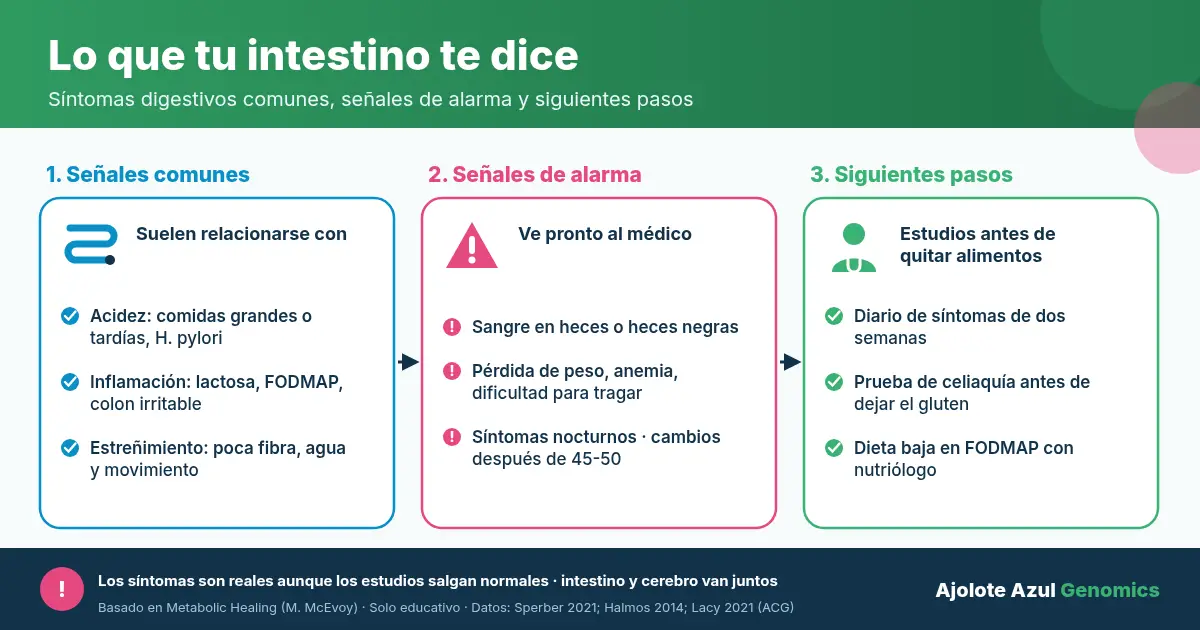
Digestive Symptoms: What Your Gut Is Telling You
Bloating, heartburn, or constipation can have several causes. Learn the warning signs and how a genetic test looks at lactose, gluten, and B12.
8 min readRead more

Wellness
How a Virus Infects a Cell and How the Body Defends
Step by step: how a virus hijacks a cell to multiply, and the defenses your body uses—interferons, sensors, and apoptosis.
5 min readRead more
Did you like this article?
Discover how you can optimize your health with a personalized nutrigenetic test