Back to blog
Pharmacogenetics
What Is Pharmacogenetics and How Does It Work?
5 min read
Ajolote Azul Team
pharmacogenetics
what is pharmacogenetics
medications and genetics
personalized medicine
CYP2D6
genetic test
Have you ever taken a medication that works wonders for your partner or sibling but makes you feel awful? Or worse: an antibiotic, an antidepressant or a painkiller that simply had no effect? It's not luck or coincidence: it's biology. And it has a name: pharmacogenetics.
Imagine going to the doctor and, instead of trying and failing several times, being able to anticipate which drug will suit you based on your DNA. In this guide we explain what pharmacogenetics is, how it works and why it has become a key piece of personalized medicine.
Worried about how you react to medications? Discover Ajolote Azul's pharmacogenetics test.
What does pharmacogenetics study?
Pharmacogenetics is the science that studies how your genes affect the way your body responds to medications. It's not magic: it's biology.
Your body has enzymes (proteins) that process and eliminate drugs, and those enzymes are encoded by your genes. If you carry a variant that makes an enzyme work slower or faster than normal, the medication can:
- Build up in your blood and cause side effects, or
- Be eliminated too quickly and have no effect at all.
That's why the same medication, at the same dose, can be perfect for one person and ineffective (or risky) for another.
How does genetics influence the medications you take?
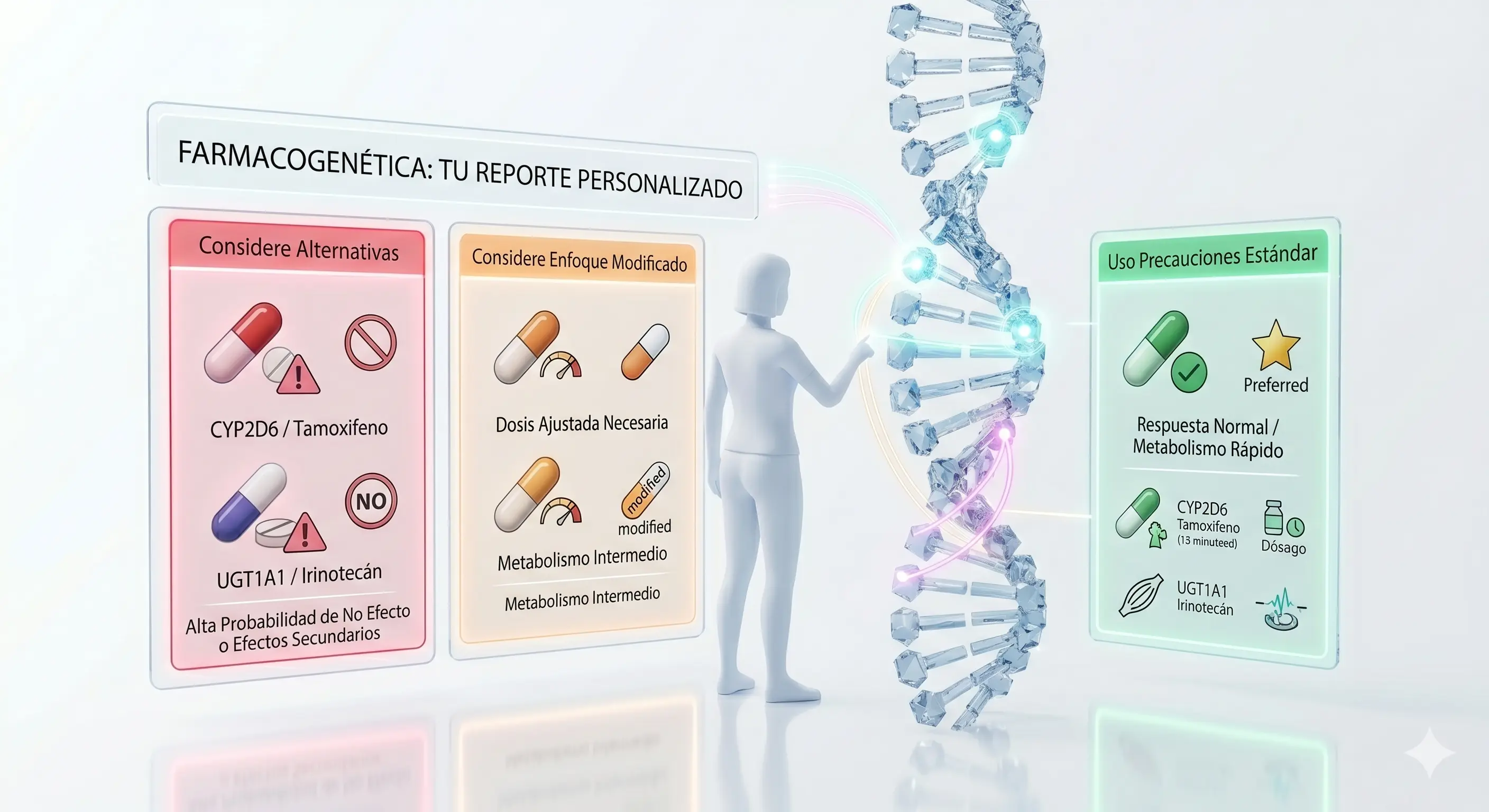
A pharmacogenetics report like the Nutrigenomix one we offer at Ajolote Azul translates your variants into easy-to-understand categories:
| Category | Color | What it means | | ------------------------------------ | ----------------- | ------------------------------------------------------------------------------------------------------- | | Consider Alternatives | Red | The drug probably won't work well for you or may cause side effects. Better to look for another option. | | Consider Modified Approach | Orange | It may work, but you might need to adjust the dose or monitor closely. | | Use Standard Precautions | Green | No variants affecting that drug were detected: you can take it normally. | | Use Standard Precautions (Preferred) | Green with a star | Your genes even make that drug work better than usual. |
A complete report can analyze more than 200 common medications: painkillers, antidepressants, anticoagulants, cholesterol and blood-pressure drugs, asthma and ADHD medications, and many more.
Want to know which drugs match your DNA? Take your pharmacogenetics test with Ajolote Azul.
What benefits can a pharmacogenetic test offer?
Knowing your pharmacogenetic profile can make a huge difference. Some real examples make it clear:
- Codeine: if your body converts it into morphine too quickly, it can cause strong side effects. The test flags this before you take it.
- Irinotecan (chemotherapy for colorectal cancer): it converts into a potent substance called SN-38, which the UGT1A1 gene is responsible for clearing. With the *28/*28 or *1/*28 variants, your body clears it more slowly, with a higher risk of severe neutropenia and intense diarrhea. The report recommends adjusting the dose or seeking alternatives from the start.
- Tamoxifen (estrogen receptor-positive breast cancer): it's a "pro-drug" that the CYP2D6 gene transforms into its active form (endoxifen). If you're a slow or intermediate metabolizer, you produce less endoxifen and the drug may be less effective, so it's worth discussing alternatives with your oncologist.
The benefits, in short:
- Avoid serious side effects before they happen.
- Get the right drug and dose on the first try.
- Reduce the classic "trial and error" with treatments.
- Make more informed decisions together with your doctor.
When should you consider a pharmacogenetic test?
It's especially worth it if you relate to any of these situations:
- You feel like "medications don't work on you."
- You tend to have unusual or stronger-than-normal side effects.
- You take several drugs at once (polypharmacy).
- You have a history of adverse reactions.
- You're about to start an important treatment (chemotherapy, antidepressants, anticoagulants, etc.).
What's the difference between pharmacogenetics and personalized medicine?
This is a frequent question, and the answer is simple: pharmacogenetics is a tool within the broader approach of personalized medicine.
| Concept | What it covers | | --------------------- | ---------------------------------------------------------------------------------------------------------- | | Pharmacogenetics | How your genes specifically influence your response to medications | | Personalized medicine | A comprehensive approach that tailors prevention and treatment to your genetics, lifestyle and environment |
In other words: pharmacogenetics feeds personalized medicine with objective data about how you process drugs. And one important point: it doesn't replace medical judgment, it empowers it, giving your doctor scientific information to decide what's best for your body, not for the average person.
In short: why pharmacogenetics can change your relationship with medications
Pharmacogenetics is no longer a thing of the future: it's a tool available today that can save you doctor visits, side effects and a lot of frustration. Knowing in advance which medications work for you and which to avoid gives you something priceless: peace of mind.
If you've ever felt that medications "don't work on you" or that you always get strange reactions, this test is for you.
Take your pharmacogenetics test now with Ajolote Azul or book a consultation to clear up your questions. It's very simple (just saliva) and within a few weeks you'll have a clear report with more than 200 medications analyzed based on your DNA.
Want to dig deeper? Continue with these guides:
- What is a genetic test and what can it reveal?
- Differences between nutrigenetics and pharmacogenetics
- What can a genetic test reveal?
Sources
A
Ajolote Azul Team
Specialist in wellness, nutrition and holistic health. Passionate about sharing science-based knowledge to improve quality of life.
Keep Reading
Related Articles
Discover more content on this topic that might interest you

Pharmacogenetics
Pharmacogenetic Test for Medications
Learn what a pharmacogenetic test for medications analyzes and how it can help you understand your body’s response to different treatments.
4 min readRead more

Pharmacogenetics
How to know which medication works best for me based on my genetics?
Learn how genetics provides information about your body's response to certain medications and how a pharmacogenetic test helps you decide.
3 min readRead more
Pharmacogenetics
Genetics and medication response: what your DNA can reveal
Discover how genetics and medication response are connected, and what your DNA can reveal to understand the variability between people.
3 min readRead more
Did you like this article?
Discover how you can optimize your health with a personalized nutrigenetic test