
Back to blog
Pharmacogenetics
Pharmacogenetic Test for Medications
4 min read
Ajolote Azul Team
pharmacogenetic test
pharmacogenetics medications
PGx test
medication response
CYP2D6
CYP2C19
Have you ever been prescribed a medication that simply had no effect? Or one that caused you strong side effects while it works wonderfully for others? It's not a coincidence: your genetics directly influences how your body processes medications.
A pharmacogenetic test lets you know in advance which drugs will work well for you, which could cause problems and for which you should adjust the dose. In this guide we explain what it analyzes, what information it offers and how its results are interpreted.
Want to stop trying and failing with your medications? Discover Ajolote Azul's PGx Test.
What does a pharmacogenetic test analyze?
At Ajolote Azul, the PGx Test (Complete Pharmacogenetics) analyzes more than 100 medications and gives you a clear report with specific recommendations for your doctor. It evaluates genes responsible for processing drugs to determine whether you're a slow, normal, fast or ultra-rapid metabolizer, and includes categories such as antidepressants, painkillers, anticoagulants, cholesterol drugs, ADHD medications, anticonvulsants and many more.
What is the relationship between genes and medications?
Your body processes and eliminates drugs through enzymes encoded by your genes. If a variant makes an enzyme work slower or faster than normal, the medication may build up (and cause side effects) or be eliminated too quickly (and have no effect). Three real examples:
| Medication | Gene | What can happen | | --------------------------- | ------- | ----------------------------------------------------------------------------------------------------------------------------------------------------- | | Codeine and tramadol (pain) | CYP2D6 | Ultra-rapid metabolizers convert them into morphine very quickly: risk of dizziness, nausea or overdose. The test suggests safer alternatives. | | Tamoxifen (breast cancer) | CYP2D6 | Certain variants don't convert it well into its active form (endoxifen), reducing its effectiveness. Allows considering other options from the start. | | Clopidogrel (anticoagulant) | CYP2C19 | In "poor metabolizers" it can be much less effective, increasing cardiovascular risk. The doctor can choose an alternative anticoagulant. |
What information can the report offer?
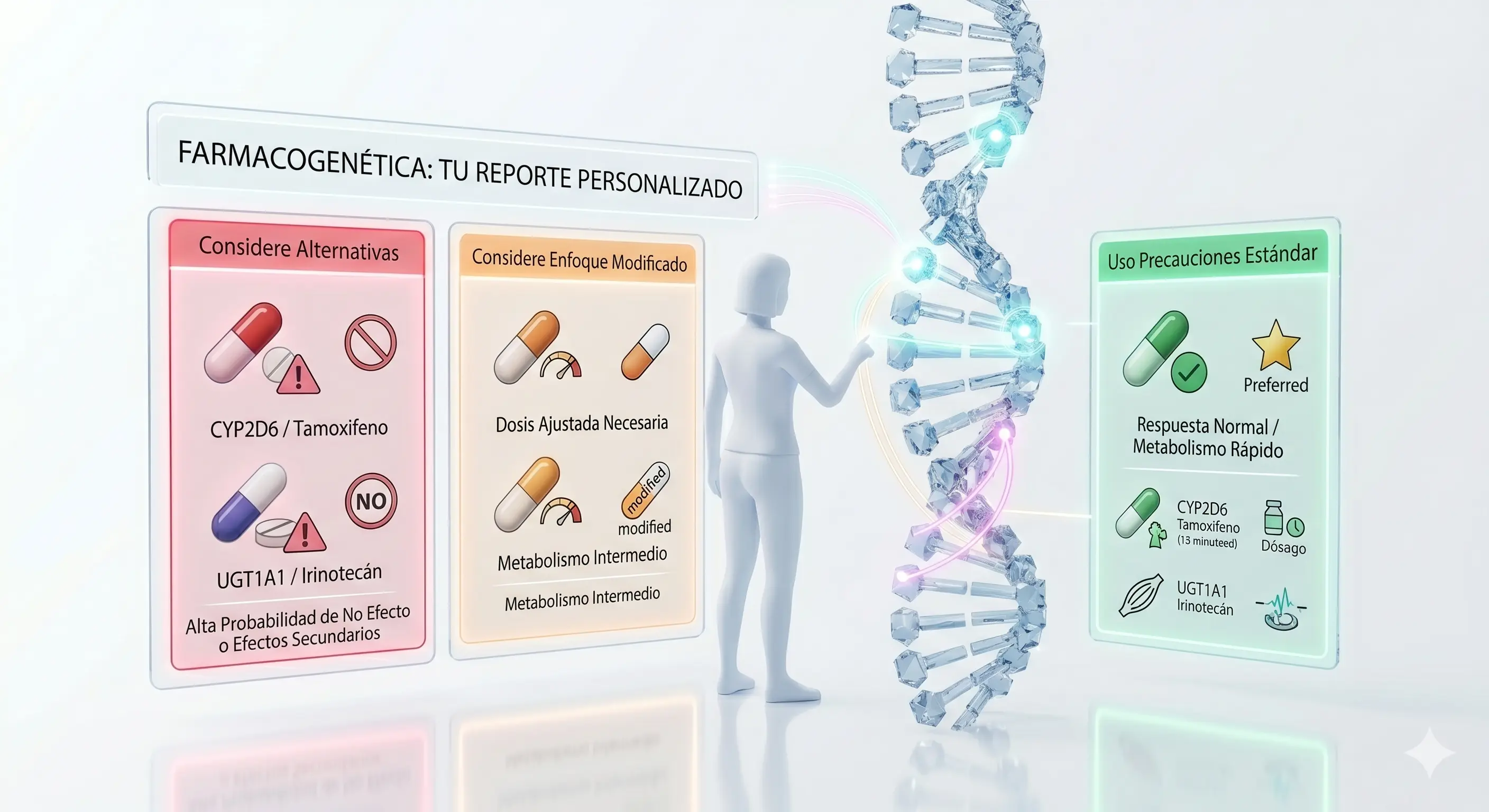
The report translates your variants into very easy-to-understand visual classifications:
- Consider Alternatives (red): it probably won't work well for you or may cause side effects.
- Consider Modified Approach (orange): it may work, but you might need to adjust the dose or monitor.
- Use Standard Precautions (green): no relevant variants; use it normally.
- Use Standard Precautions (Preferred) (green with a star): it even works better than usual.
This way, instead of trial and error, you arrive at your doctor's office with objective information about your genetics.
Ready for medication tailored to you? Take your PGx Test with Ajolote Azul and bring it to your appointment.
In which cases can a pharmacogenetic test be considered?
It's especially worth it if:
- You feel that medications don't work on you.
- You tend to have strong or unusual side effects.
- You take several drugs at once.
- You're about to start an important treatment (oncology, psychiatric, anticoagulant).
- You want to avoid months of trial and error.
How are the results interpreted?
A few keys to make the most of them:
- Focus on the classification and recommendation, not the technical gene names.
- Always share it with your doctor: the pharmacogenetic part is applied with a professional.
- Keep it on hand for future prescriptions (it's information that doesn't expire).
- Remember the context: age, weight, other conditions and drugs you already take also matter.
In short: why can a pharmacogenetic test change your treatments?
Instead of accepting that "medications sometimes don't work," a pharmacogenetic test gives you the missing data to receive safer, more effective and personalized treatments from day one. It doesn't replace your doctor: it enhances them.
The PGx Test from Ajolote Azul costs $9,800 MXN and includes a clinical report ready to share with your doctor. Take your PGx Test now or book a consultation. Your body processes medications in a unique way; now you can know exactly how.
Want to dig deeper? We recommend:
- What is pharmacogenetics and how does it work?
- Genetics and personalized medicine: what you should know
- How much does a genetic test cost in Mexico?
Sources
A
Ajolote Azul Team
Specialist in wellness, nutrition and holistic health. Passionate about sharing science-based knowledge to improve quality of life.
Keep Reading
Related Articles
Discover more content on this topic that might interest you
Pharmacogenetics
What Is Pharmacogenetics and How Does It Work?
Discover what pharmacogenetics is, how your genetics influences your response to medications and why it is key to personalized medicine.
5 min readRead more

Pharmacogenetics
How to know which medication works best for me based on my genetics?
Learn how genetics provides information about your body's response to certain medications and how a pharmacogenetic test helps you decide.
3 min readRead more

Pharmacogenetics
Genetics and medication response: what your DNA can reveal
Discover how genetics and medication response are connected, and what your DNA can reveal to understand the variability between people.
3 min readRead more
Interested in pharmacogenetic testing (PGx)?
Pricing, covered medications, and how to book your consult.