Based on the work of our partners at Metabolic Healing (Michael McEvoy). Read the original article: Glutathione & Detoxification: The Methylation Connection
Methylation and glutathione are connected: the homocysteine produced by the methylation cycle can be converted into cysteine, the ingredient that limits glutathione production. That is why folate, B12, B6, and genes such as MTHFR and NRF2 matter for your antioxidant defenses. Here is how this connection works and what you can do to support it.
If you have read about MTHFR or NRF2, you have surely run into two words that seem to show up everywhere: methylation and glutathione. They are often presented apart, but one metabolic bridge joins them. Understanding it explains why B-complex vitamins, protein, and certain genes matter for your antioxidant defenses.
What is glutathione?
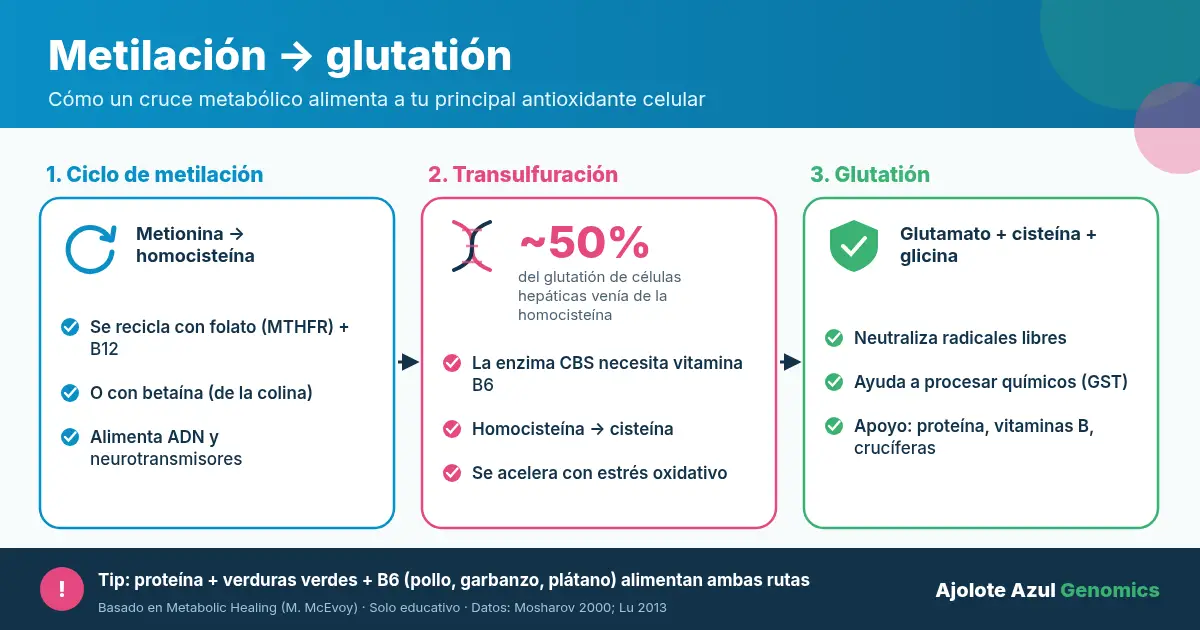
Glutathione (abbreviated GSH) is a small molecule made of three amino acids: glutamate, cysteine, and glycine. It is the most abundant antioxidant your own cells produce, and it helps 1:
- Neutralize reactive oxygen species produced by normal metabolism, exercise, pollution, and tobacco.
- Process and clear external substances, such as some environmental chemicals and medications, through enzymes called glutathione S-transferases (GST).
- Recycle other antioxidants, such as vitamins C and E.
- Support immune cells and regulate cell growth and repair.
Glutathione keeps shifting between a reduced form (GSH, ready to work) and an oxidized form (GSSG, already used). Cells recycle it, but they also need to keep making more.
How your body makes glutathione
Synthesis takes place in two steps inside cells. The first, carried out by the enzyme glutamate-cysteine ligase (GCL), is the bottleneck, and its speed depends above all on how much cysteine is available 1. Glutamate and glycine are usually more plentiful.
The key question, then, is where your cysteine comes from. Partly from the protein in food, and partly from the methylation cycle.
The bridge: from methylation to glutathione
The methylation cycle uses the amino acid methionine to donate methyl groups to hundreds of reactions, from DNA to neurotransmitters. Its byproduct is homocysteine, which has two possible fates:
- Recycling back to methionine, with help from methylfolate (produced by MTHFR) and vitamin B12, or from betaine that comes from choline.
- Transsulfuration: conversion into cystathionine by the enzyme cystathionine beta-synthase (CBS) and then into cysteine, which can be used to make glutathione.
This second route carries a lot of weight. In human liver cells, about half of the glutathione came from homocysteine through transsulfuration. And when the cells were exposed to oxidative stress, flow through this route increased 1.6- to 2.1-fold, as if the cells were prioritizing glutathione production 2.
That is the central connection: methylation and glutathione share the same supply line.
Vitamin B6: the forgotten helper
CBS and the next enzyme in transsulfuration need the active form of vitamin B6 (pyridoxal 5'-phosphate, PLP). Low B6 may be more common than people think. In a large survey in the United States of more than 6,000 people, low PLP levels were common in some groups even with intakes close to the recommended amount. Most women who used oral contraceptives had low B6, and smokers and older adults were also at higher risk 3.
Good food sources of B6: chicken, fish, liver, potato, banana, chickpeas, pistachios, and sunflower seeds.
Genes that influence this pathway
Several genes can change how well this system works:
- MTHFR, MTR, MTRR: they influence homocysteine recycling and the use of folate and B12.
- CBS: the gateway into transsulfuration.
- GCLC and GCLM: the enzyme that assembles glutathione.
- GSTM1, GSTT1, GSTP1: enzymes that use glutathione to process substances. GSTM1 and GSTT1 are missing entirely (they are deleted) in a considerable share of people.
- NRF2 (NFE2L2): the master switch that turns on the genes that make glutathione.
Having a variant does not mean you have a deficiency. Your nutrient status, your diet, your exposures, and many genes interact. A good nutrigenetic report looks at them as a network.
Do your genes influence your methylation and your glutathione?
They can. The NGx nutrigenetic test analyzes 70 markers in 59 genes and includes MTHFR (folate), vitamin B12, and NRF2 plus antioxidant markers. It does not diagnose any disease: it gives you information to discuss with your doctor or your nutritionist. Learn more about the Ajolote Azul genetic test and read what a mutation in the MTHFR gene means.
How can you support your glutathione?
Eat enough protein, including sulfur-rich foods
Cysteine and its precursor, methionine, come from protein: eggs, chicken, fish, dairy, beans, and lentils. Sulfur-rich vegetables, such as broccoli, cabbage, cauliflower, onion, and garlic, also support the antioxidant system.
Cover the methylation cofactors
Folate (leafy green vegetables, beans), B12 (foods from animals; if you follow a vegan diet, ask your doctor about supplements), B6, B2, and choline keep both homocysteine routes working.
What the evidence says about precursors
In a small study, older adults had less glutathione than younger adults because they produced less. Two weeks of cysteine (as N-acetylcysteine) plus glycine raised their glutathione by about 95% and reduced markers of oxidative stress 4. Larger studies are underway, and any supplement should be discussed with a professional, especially if you take medications.
And glutathione itself
For years, oral glutathione was thought to be barely absorbed. A 6-month randomized trial in 54 adults found that 250 or 1,000 mg a day increased glutathione stores in blood and in other cells, and that levels returned to their starting point one month after it was stopped 5. Whether that translates into health benefits has not been shown yet.
Reduce the demand
Not smoking, moderating alcohol, avoiding unnecessary exposure to solvents and pesticides, and sleeping well reduce the demand on your glutathione.
Frequently asked questions
How are methylation and glutathione related?
Homocysteine, a byproduct of methylation, can be converted into cysteine through the transsulfuration pathway. Cysteine is the component that limits glutathione production. In liver cells, about half of the glutathione came from this route.
Which vitamins help produce glutathione?
Vitamin B6 is indispensable for the transsulfuration enzymes. Folate, B12, B2, and choline support the methylation side. Protein supplies cysteine, glycine, and glutamate.
Does N-acetylcysteine raise glutathione?
In a small study of older adults, N-acetylcysteine together with glycine raised glutathione and reduced markers of oxidative stress within two weeks. Check with a professional before taking it, because it can interact with some medications.
Do glutathione supplements work?
A 6-month trial showed that oral glutathione increased levels in blood and cells. Clinical benefits are still being studied.
Turn your genes into a practical plan
- Nutrigenetic test NGx: 70 markers in 59 genes, with a 60-minute 1-on-1 consult included. $9,880 MXN.
- Pharmacogenetic test PGx: how you process more than 200 medications (51 genes). $9,800 MXN.
- NGx + PGx combo: $15,750 MXN. See the tests
References
- Lu SC. Glutathione synthesis. Biochim Biophys Acta. 2013;1830(5):3143-3153. doi:10.1016/j.bbagen.2012.09.008. PubMed 22995213 · Free full text (PMC) · doi:10.1016/j.bbagen.2012.09.008
- Mosharov E, Cranford MR, Banerjee R. The quantitatively important relationship between homocysteine metabolism and glutathione synthesis by the transsulfuration pathway and its regulation by redox changes. Biochemistry. 2000;39(42):13005-13011. doi:10.1021/bi001088w. PubMed 11041866 · doi:10.1021/bi001088w
- Morris MS, Picciano MF, Jacques PF, Selhub J. Plasma pyridoxal 5'-phosphate in the US population: the National Health and Nutrition Examination Survey, 2003-2004. Am J Clin Nutr. 2008;87(5):1446-1454. doi:10.1093/ajcn/87.5.1446. PubMed 18469270 · doi:10.1093/ajcn/87.5.1446
- Sekhar RV, Patel SG, Guthikonda AP, et al. Deficient synthesis of glutathione underlies oxidative stress in aging and can be corrected by dietary cysteine and glycine supplementation. Am J Clin Nutr. 2011;94(3):847-853. doi:10.3945/ajcn.110.003483. PubMed 21795440 · Free full text (PMC) · doi:10.3945/ajcn.110.003483
- Richie JP Jr, Nichenametla S, Neidig W, et al. Randomized controlled trial of oral glutathione supplementation on body stores of glutathione. Eur J Nutr. 2015;54(2):251-263. doi:10.1007/s00394-014-0706-z. PubMed 24791752 · doi:10.1007/s00394-014-0706-z
This article is for information and education only; it does not replace consultation, diagnosis, or treatment by a health professional. Talk with your doctor before changing your diet, medications, or supplements.
Based on the work of our partners at Metabolic Healing (Michael McEvoy). Read the original article: Metabolic Healing
Ajolote Azul Team
Specialist in wellness, nutrition and holistic health. Passionate about sharing science-based knowledge to improve quality of life.