Back to blog
Wellness
MTHFR gene: what the famous variant is, why it is so common in México, and what to do
8 min read
Ajolote Azul Team
MTHFR
C677T
folate
homocysteine
México
nutrigenetics
Based on the work of our partners at Metabolic Healing (Michael McEvoy). Read the original article: What Is MTHFR & Why Is It Significant For Your Health?
Few genes are searched online as often as MTHFR. Some pages blame it for almost everything, and others dismiss it completely. The reality sits in the middle, and in México it matters a great deal, because the best-studied variant is especially common here.
Here is what this gene does, what it really means to have a "mutation," and how to use that information with a cool head.
What is the MTHFR gene for?
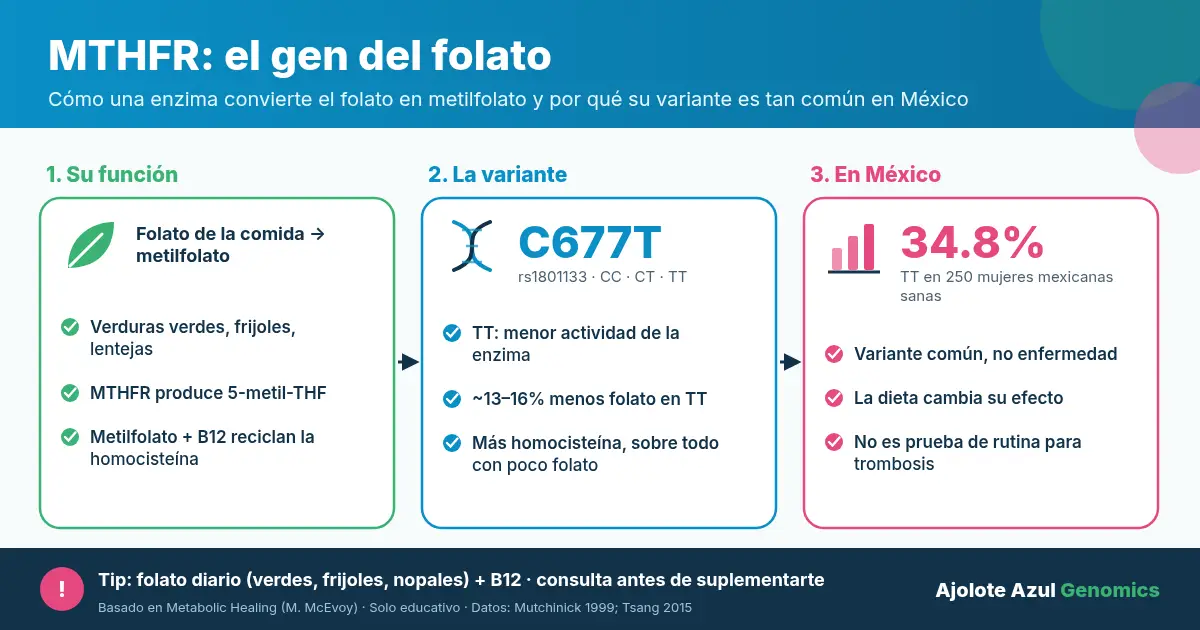
MTHFR stands for methylenetetrahydrofolate reductase, an enzyme your cells use to process folate (vitamin B9). Folate from food (leafy greens, beans, lentils) and folic acid from fortified products pass through several steps before the body can use them. MTHFR handles one of the last steps: it produces 5-methyltetrahydrofolate (methylfolate), the form that circulates in the blood.
Methylfolate has a key job: it donates a methyl group so that homocysteine, a byproduct of protein metabolism, is converted back into the amino acid methionine. Vitamin B12 also takes part in that step. Methionine, in turn, feeds methylation, a chemical process involved in making DNA, neurotransmitters, and many other molecules.
When that recycling slows down, homocysteine can build up in the blood.
What is an MTHFR "mutation"?
Strictly speaking, most people do not have a mutation. They have a common variant (a polymorphism) shared by a great many healthy people. The two best known are:
- C677T (rs1801133). It changes one amino acid in the enzyme. In the study that first described it, the variant enzyme was thermolabile: it lost activity more easily and worked less efficiently. People with two copies (TT genotype) had higher homocysteine levels 1.
- A1298C (rs1801131). Its effect on enzyme activity seems smaller, and the evidence on its impact on health is weaker.
We all inherit two copies of the gene, one from mom and one from dad. So for C677T you can be CC (the typical form), CT (one copy), or TT (two copies). Lower enzyme activity is seen mainly in TT.
Why MTHFR is so relevant in México
The C677T variant is very common around the world, but its frequency changes with ancestry, and México has some of the highest figures that have been reported. In a study of 250 healthy Mexican women, 34.8% had the TT genotype, and more than half of all copies of the gene carried the T allele 2.
Put another way: about one in three participants had the version associated with lower enzyme activity. It is not rare and, by itself, it is not a disease.
What the variant does do (and what it does not)
Folate levels
The clearest and best measured effect is on folate. A large meta-analysis found a stepwise pattern: blood folate was higher in CC, intermediate in CT, and lower in TT. People with TT had about 13% less serum folate and 16% less red-blood-cell folate than people with CC 3.
It is a real but moderate difference, and diet can make up a good part of it.
Homocysteine and the heart
High homocysteine has been linked with cardiovascular disease, so researchers looked at whether people with TT have more heart problems. A pooled analysis published in JAMA found that the TT genotype was associated with a 16% higher chance of coronary heart disease, and that the relationship was stronger when folate intake was low. In the North American studies, where flour is fortified with folic acid, no clear association appeared 4.
The conclusion is that folate from the diet seems to change what the variant means. That is exactly the idea of nutrigenetics: the gene weighs more when diet does not compensate for it.
Clots and pregnancy
You may have read that MTHFR causes thrombosis or miscarriages. The American College of Medical Genetics and Genomics (ACMG) reviewed the evidence and recommends against including MTHFR genotype in the routine workup for thrombophilia (clotting disorders) or in the evaluation of recurrent pregnancy loss 5. When the doctor needs that information, a blood homocysteine test is more useful.
One point stands: folic acid before and early in pregnancy is recommended for anyone who could become pregnant, regardless of genotype. That advice does not depend on an MTHFR test.
Want to know your MTHFR variant? Ajolote Azul's NGx nutrigenetic test includes MTHFR and folate metabolism, plus vitamin B12 and 70 markers. Your results come with a 1-to-1 consultation so you know what they mean for your diet. Questions? Book a free 15-minute call.
I have the variant. What do I do now?
First: stay calm. A CT or TT result is information, not a diagnosis. These practical steps make sense for most people:
- Eat folate-rich foods every day. Spinach, Swiss chard, quelites (wild greens), nopales (cactus pads), broccoli, beans, lentils, chickpeas, and avocado are good sources.
- Secure your vitamin B12. It works as a team with folate. It is in animal foods; if you eat a vegetarian or vegan diet, ask a professional about a supplement.
- Do not forget B6 and riboflavin (B2). They support other steps of the same pathway. Eggs, dairy, fish, chicken, and seeds help.
- Ask about a homocysteine test. If your doctor considers it relevant (for example, if there is a family history of heart attack), this test shows how the pathway is working in practice.
- Check before you supplement. You will see "methylfolate" advertised as the solution for MTHFR. Some professionals use it, but a higher dose is not always better. Look for a recommendation that takes your lab results, your medications, and your stage of life into account, especially in pregnancy.
MTHFR is only one gene among many
Folate and methylation depend on a network of genes, such as MTR, MTRR, CBS, and BHMT, plus vitamins B12, B6, and B2, choline, and your diet overall. Looking at a single SNP in isolation can be confusing. A good genetic report puts each variant in context and turns it into concrete decisions on your plate.
Frequently asked questions
Is it dangerous to have the MTHFR mutation?
For most people, no. The C677T and A1298C variants are shared by millions of healthy people. Those who are TT usually have somewhat less folate and more homocysteine, especially on a low-folate diet; that is why diet and B-complex vitamins matter more for them.
How common is MTHFR C677T in México?
Very common. In a study of healthy Mexican women, about 35% had the TT genotype, one of the highest frequencies reported in the world.
Should I take methylfolate if I have the MTHFR variant?
Not automatically. The foundation is a folate-rich diet and enough B12. If you need a supplement, which form and which dose, that is something to decide with a professional, ideally with tests such as homocysteine.
Does MTHFR cause thrombosis or miscarriage?
Medical genetics guidelines do not recommend MTHFR testing to evaluate clotting disorders or recurrent pregnancy loss, because the variant alone has not been shown to be useful for those decisions. Talk with your doctor about the right tests for your case.
Turn your genes into a practical plan
- NGx nutrigenetic test: 70 markers of nutrition, vitamins, intolerances, metabolism, and more, with a 1-to-1 consultation included. $9,880 MXN.
- PGx pharmacogenetic test: how you process more than 200 medications. $9,800 MXN.
- NGx + PGx combo: $15,750 MXN. See the tests · Book your free 15-min call · Message us on WhatsApp
References
- Frosst P, Blom HJ, Milos R, et al. A candidate genetic risk factor for vascular disease: a common mutation in methylenetetrahydrofolate reductase. Nat Genet. 1995;10(1):111-113. doi:10.1038/ng0595-111. PubMed 7647779 · doi:10.1038/ng0595-111
- Mutchinick OM, López MA, Luna L, Waxman J, Babinsky VE. High prevalence of the thermolabile methylenetetrahydrofolate reductase variant in Mexico: a country with a very high prevalence of neural tube defects. Mol Genet Metab. 1999;68(4):461-467. doi:10.1006/mgme.1999.2939. PubMed 10607475 · doi:10.1006/mgme.1999.2939
- Tsang BL, Devine OJ, Cordero AM, et al. Assessing the association between the methylenetetrahydrofolate reductase (MTHFR) 677C>T polymorphism and blood folate concentrations: a systematic review and meta-analysis of trials and observational studies. Am J Clin Nutr. 2015;101(6):1286-1294. doi:10.3945/ajcn.114.099994. PubMed 25788000 · doi:10.3945/ajcn.114.099994
- Klerk M, Verhoef P, Clarke R, Blom HJ, Kok FJ, Schouten EG. MTHFR 677C-->T polymorphism and risk of coronary heart disease: a meta-analysis. JAMA. 2002;288(16):2023-2031. doi:10.1001/jama.288.16.2023. PubMed 12387655 · doi:10.1001/jama.288.16.2023
- Hickey SE, Curry CJ, Toriello HV. ACMG Practice Guideline: lack of evidence for MTHFR polymorphism testing. Genet Med. 2013;15(2):153-156. doi:10.1038/gim.2012.165. PubMed 23288205 · doi:10.1038/gim.2012.165 · Erratum published: Genet Med. 2020 Dec;22(12):2125.
This article is for information and education only; it does not replace consultation, diagnosis, or treatment by a health professional. Talk with your doctor before changing your diet, your medications, or your supplements.
Based on the work of our partners at Metabolic Healing (Michael McEvoy). Read the original article: Metabolic Healing
A
Ajolote Azul Team
Specialist in wellness, nutrition and holistic health. Passionate about sharing science-based knowledge to improve quality of life.
Keep Reading
Related Articles
Discover more content on this topic that might interest you
Wellness
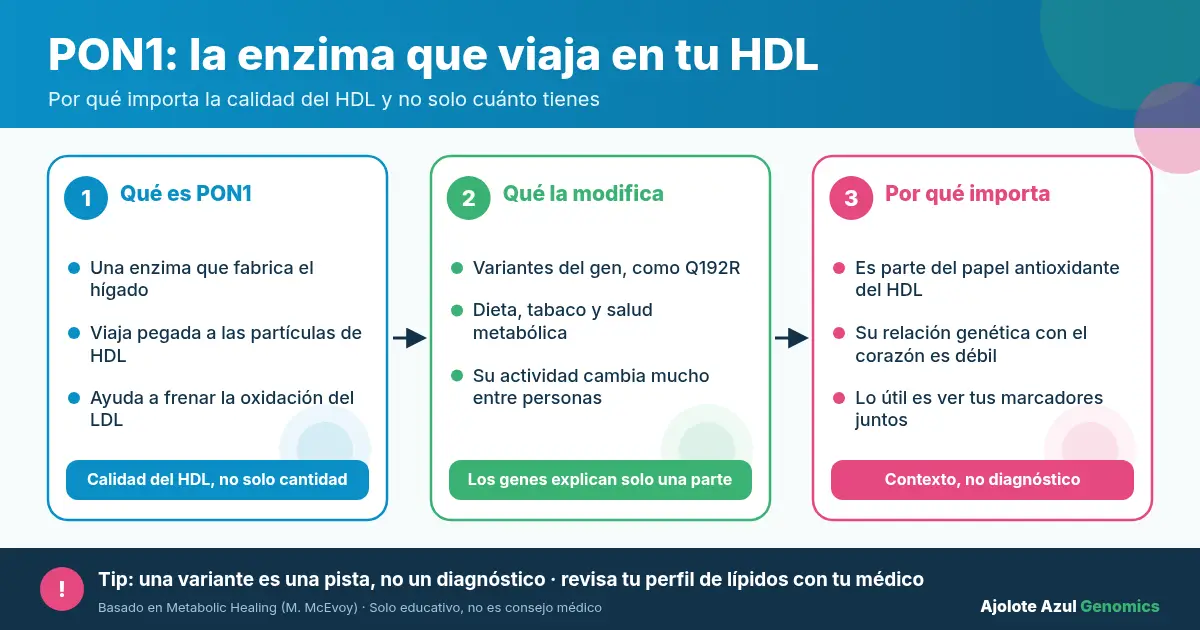
PON1 Gene: Function, HDL, and the Q192R Variant
What does the PON1 gene do? How it relates to paraoxonase, HDL cholesterol, and the Q192R variant—what the evidence shows and its limits.
7 min readRead more
Wellness
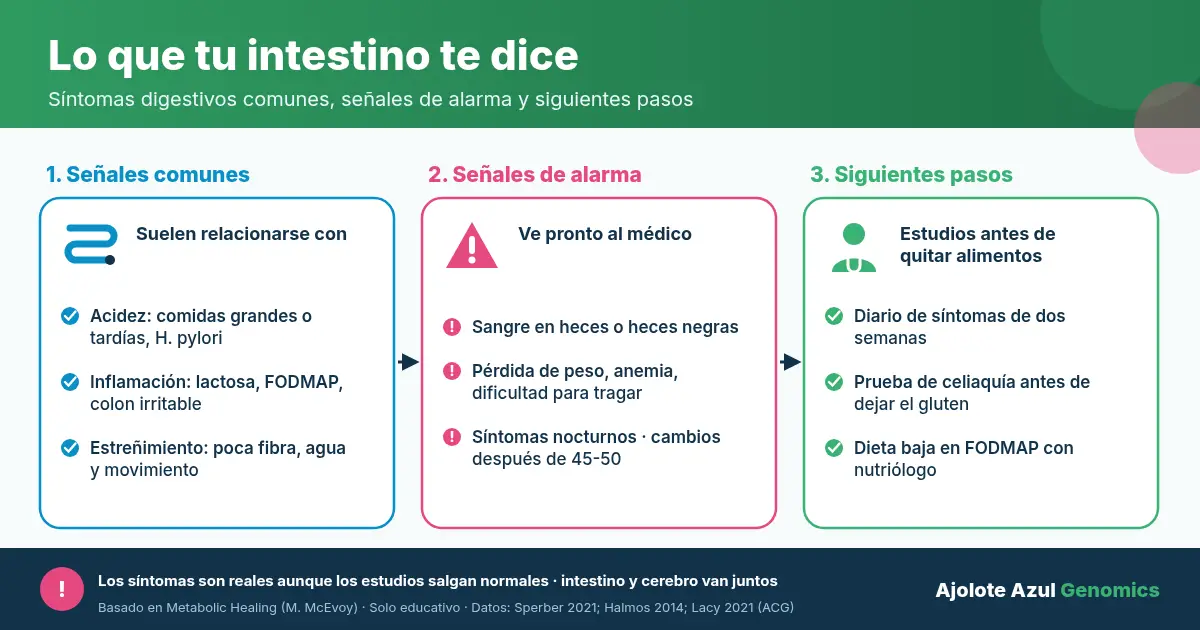
Digestive Symptoms: What Your Gut Is Telling You
Bloating, heartburn, or constipation can have several causes. Learn the warning signs and how a genetic test looks at lactose, gluten, and B12.
8 min readRead more

Wellness
How a Virus Infects a Cell and How the Body Defends
Step by step: how a virus hijacks a cell to multiply, and the defenses your body uses—interferons, sensors, and apoptosis.
5 min readRead more
Did you like this article?
Discover how you can optimize your health with a personalized nutrigenetic test