Back to blog
Wellness
Mitochondria and Water: How Your Cells Make Energy
6 min read
Ajolote Azul Team
mitochondria
ATP
cellular energy
hydration
interfacial water
wellness
The mitochondrion is the part of the cell that turns nutrients from food and oxygen into ATP, the energy your cells use—and in that process it also makes water. So your hydration, what you eat, and your habits influence how your cellular metabolism works.
The ordered water of life: how interfacial alignment may support cellular energy
Most people picture water inside cells as a simple solvent: a passive medium that dissolves ions, carries metabolites, and keeps proteins from sticking together. Research over the last two decades suggests a richer picture. On the charged, crowded surfaces that dominate the cell interior, water can organize into more ordered networks whose dielectric and dynamic properties differ from ordinary bulk water. These interfacial layers may influence electron transfer, membrane function, and even aspects of blood rheology. The ideas remain partly exploratory, but they build on published observations about water structure, membrane electrostatics, and electron-transfer kinetics.
Bulk water versus interfacial water
In bulk liquid water at room temperature, the dielectric constant is about 78. Water molecules reorient quickly; their permanent dipoles point in essentially random directions and largely cancel one another. The result is high but isotropic polarizability that screens charge efficiently but offers little long-range structural order.
Near hydrophilic or highly charged surfaces, the situation changes. Hydrogen-bond networks can form extended cooperative clusters. Martin Chaplin’s water-structure models, developed around the turn of the century, describe fluctuating icosahedral arrangements built from smaller tetrahedral units. These clusters can interconvert between higher- and lower-density forms and respond to surfaces or solutes. More recent experiments on water confined between atomically flat surfaces only a few nanometers apart have reported in-plane dielectric constants that rise dramatically—sometimes toward ranges associated with ferroelectric materials—when the water layer is only one or two molecules thick. Molecular dipoles become more correlated instead of random.
The extreme environment of the inner mitochondrial membrane
Nowhere is the interfacial environment more extreme than inside mitochondria. The inner mitochondrial membrane generates a transmembrane potential of roughly 150–200 mV across a lipid bilayer only about 5 nm thick. The resulting electric field intensity is on the order of 30 million volts per meter, comparable in magnitude to the field inside a lightning bolt. Cardiolipin, a unique tetra-acyl phospholipid enriched in this membrane, contributes substantial negative charge and curvature. Under such fields, water molecules next to the membrane are expected to experience strong orienting forces.
A plausible consequence is partial alignment of water dipoles parallel to one another. When dipoles are no longer randomly oriented, their mutual cancellation drops and local capacity to store or transmit electrical polarization can rise. In confined geometries this has been observed experimentally as elevated in-plane dielectric constants. Whether mitochondria sustain a comparable “ferroelectric-like” water layer remains an open question, but the physical conditions needed for strong dipole correlation are present.
Electron transfer and the role of the solvent
Electron transport along the respiratory chain is described by Marcus theory. Electron-transfer rate depends not only on driving force but also on reorganization energy of the surrounding medium: the energy cost of reorganizing solvent dipoles and ligands after the electron hops. When solvent is disordered and highly polarizable, reorganization energy is higher and transfer can become less efficient. An ordered interfacial water network whose dipoles are already partially aligned may lower that reorganization cost and favor coherent or resonant tunneling between redox centers.
If environmental factors (altered light exposure, elevated deuterium content, or changes in local magnetic environment) destabilize the ordered water layer, the network may “melt” toward bulk-like behavior. Dielectric response falls, reorganization energy rises, and electron transfer is pushed more easily toward less favorable regimes on the Marcus curve. The same ordered water is also thought to influence viscosity of the thin aqueous films that lubricate the rotary motor of ATP synthase; lab studies on interfacial water viscosity under near-infrared light are consistent with light-dependent changes in frictional properties.
Downstream effects on blood and circulation
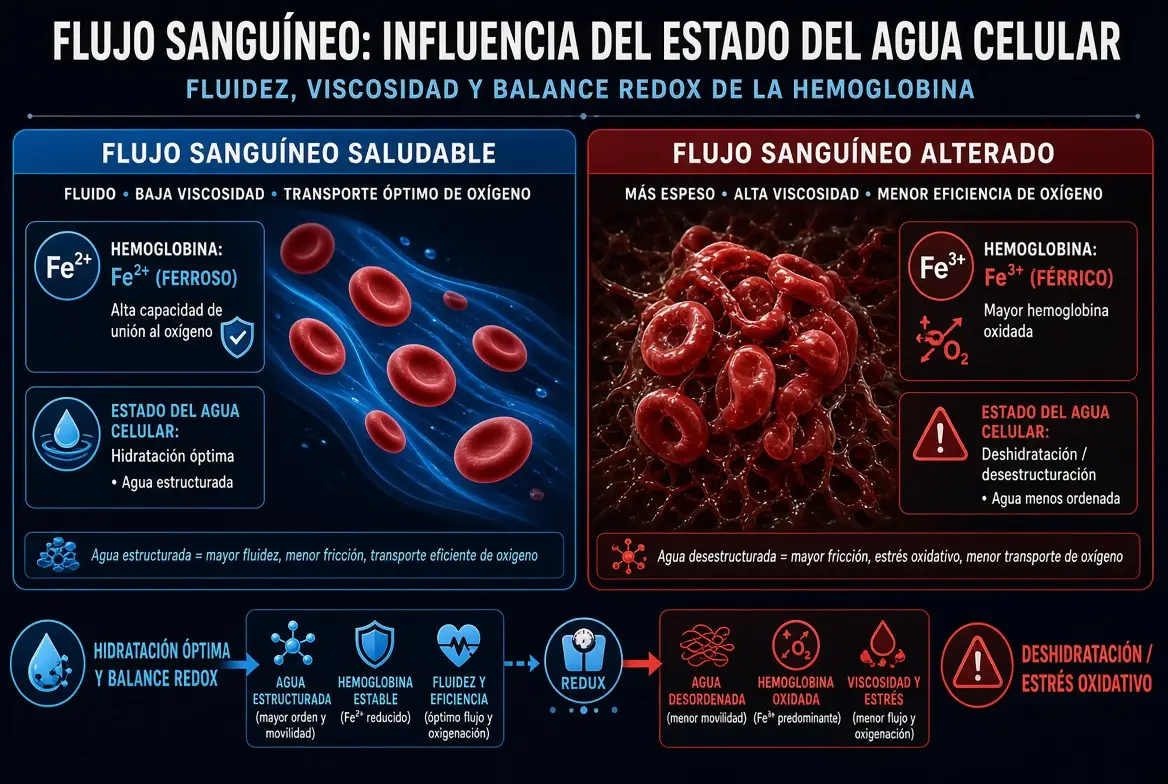
Cellular water organization is not limited to mitochondria. Red blood cell membranes and plasma proteins also present extensive hydrophilic surfaces. When interfacial water is well ordered, membrane flexibility and local charge screening may support normal red cell deformability and efficient oxygen delivery. Oxidative stress or metabolic disruption can shift hemoglobin toward the ferric (Fe³⁺) state, reduce oxygen-binding efficiency, and increase tendency of cells to aggregate. Elevated blood viscosity is a recognized risk factor for altered microcirculation. Although direct causal links from mitochondrial water structure to systemic blood rheology remain speculative, the shared dependence on interfacial water and redox balance makes the connection biologically plausible and worth studying.
Environmental influences and practical implications
Morning sunlight delivers both ultraviolet and near-infrared wavelengths that interact with cellular chromophores and water. Near-infrared light has been shown in lab settings to alter interfacial water viscosity and is widely studied in photobiomodulation research. Deuterium, the heavy hydrogen isotope, forms stronger hydrogen bonds and can slow proton and deuteron transfer; elevated tissue deuterium is hypothesized to disrupt low-density water networks that support efficient tunneling. Variations in the geomagnetic field, though weak, may influence coherence of long-range water clusters in sensitive biological systems—an idea still at the frontier of biophysical inquiry.
None of these factors acts in isolation. Practical correlates from the literature are straightforward: regular outdoor natural light (especially in the morning), adequate hydration with attention to water quality, and limiting chronic oxidative and metabolic stress. These behaviors support the physical conditions under which interfacial water is more likely to stay ordered.
A measured perspective
The picture that emerges is not that water is magical, but that it is an active, structured participant whose organization is sensitive to the extreme electrostatic environment of mitochondria and to the wider physical surroundings of the body. Classical physical chemistry (dielectric response, Marcus theory) and modern observations of confined water provide the foundation. Many biological extrapolations remain hypotheses that need direct experimental tests in living cells. Still, they offer a coherent frame for why light, hydration, and membrane charge density seem closely tied to cellular energy production and circulatory health.
If you want to see how your genes relate to nutrition, learn about our nutrigenetic test or compare all genetic tests and pricing.
Frequently asked questions
What do mitochondria do?
They produce most of a cell’s ATP from glucose, fats, and oxygen via the respiratory chain. At the end of that chain, oxygen combines with hydrogen to form water.
What habits support mitochondria?
Regular physical activity, good sleep, a varied diet with enough B vitamins, iron, and magnesium, and staying hydrated associate with better mitochondrial function.
Do my genes influence energy metabolism?
Some genetic variants influence how you process nutrients such as caffeine, fats, or certain vitamins. A nutrigenetic test can guide food choices together with a health professional.
A
Ajolote Azul Team
Specialist in wellness, nutrition and holistic health. Passionate about sharing science-based knowledge to improve quality of life.
Keep Reading
Related Articles
Discover more content on this topic that might interest you
Wellness
PON1 Gene: Function, HDL, and the Q192R Variant
What does the PON1 gene do? How it relates to paraoxonase, HDL cholesterol, and the Q192R variant—what the evidence shows and its limits.
7 min readRead more
Wellness
Digestive Symptoms: What Your Gut Is Telling You
Bloating, heartburn, or constipation can have several causes. Learn the warning signs and how a genetic test looks at lactose, gluten, and B12.
8 min readRead more
Wellness
How a Virus Infects a Cell and How the Body Defends
Step by step: how a virus hijacks a cell to multiply, and the defenses your body uses—interferons, sensors, and apoptosis.
5 min readRead more
Did you like this article?
Discover how you can optimize your health with a personalized nutrigenetic test