Back to blog
Wellness
FUT2 non-secretor gene: what it means for your microbiota
7 min read
Ajolote Azul Team
FUT2 non-secretor
gut microbiota
vitamin B12
bifidobacteria
norovirus
nutrigenetics
Based on the work of our partners at Metabolic Healing (Michael McEvoy). Read the original article: FUT2 Gene Mutations & Your Gut Flora
Trillions of microbes live in your gut, and what they eat decides which ones thrive. Diet is the biggest lever, but your genes also set the table. One gene in particular, FUT2, decides whether the lining of your gut offers a specific sugar that certain friendly bacteria love.
Here is what FUT2 does, what it means to be a "non-secretor," and what you can do with that information.
What does the FUT2 gene do?
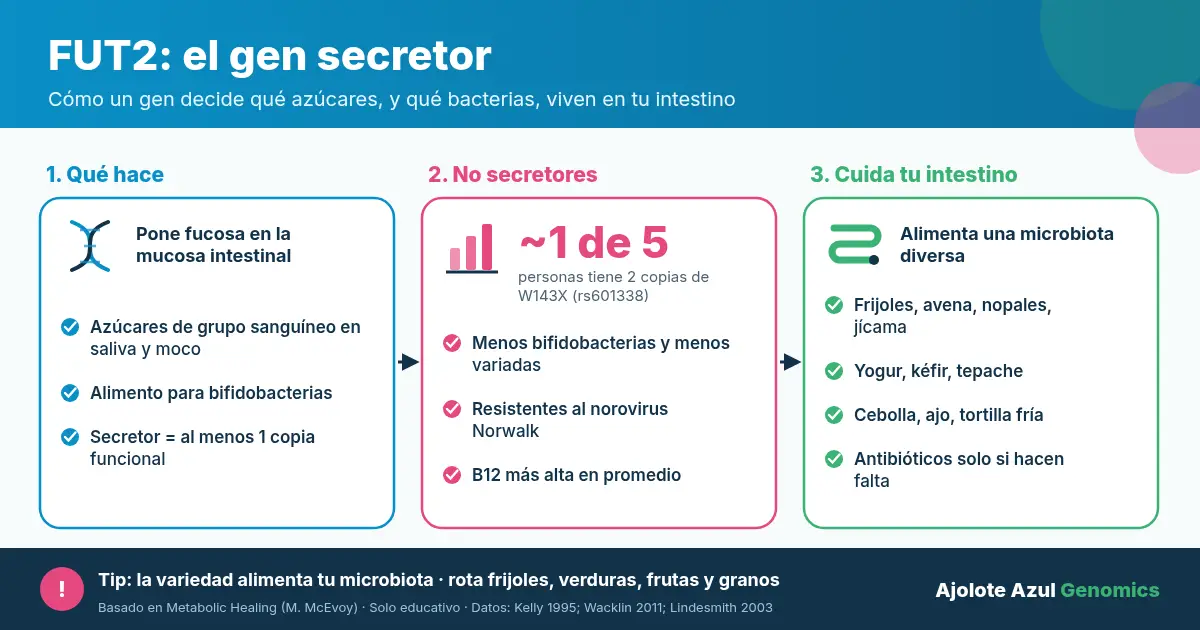
FUT2 makes an enzyme called fucosyltransferase 2. Its job is to attach a small sugar, fucose, to molecules on the surface of the cells that line the gut and to proteins in saliva, mucus, and other secretions. These fucose-bearing structures are part of the ABO blood-group system: because of them, the antigens of your blood type show up in body fluids.
People with at least one working copy of FUT2 are called secretors. People with two copies that do not work are non-secretors: their secretions and intestinal mucosa carry far fewer of these fucose sugars.
How common is it to be a non-secretor?
Quite common. In the study that identified FUT2 as the secretor gene, about 20% of people chosen at random had two copies of a "stop" variant (W143X, also called rs601338 G>A) that switches the enzyme off. That figure matched the known proportion of non-secretors in most populations 1.
Frequency changes with ancestry; in some East Asian populations, for example, a different FUT2 variant is responsible. There is little reliable data for mestizo or Indigenous populations in México, so the only way to know your status is with a genetic test.
FUT2 and your gut bacteria
Fucose on the intestinal lining is not decoration. Some bacteria use it as food, and bifidobacteria, a group linked with a healthy gut in infants and adults, are among them.
In a Finnish study of 71 healthy adults, the 14 non-secretors had significantly lower diversity, richness, and abundance of bifidobacteria than the secretors. Several types of Bifidobacterium were rare or absent in the non-secretors. Other bacterial groups, by contrast, were more varied in them 2.
That does not mean non-secretors have a "sick" gut. It means their microbial community is usually assembled differently, and that diet can matter even more in their case.
Not all bad: infections and vitamin B12
Being a non-secretor has upsides and downsides, and some of them are advantages.
- Norovirus. This virus causes most outbreaks of acute vomiting and diarrhea, and it needs fucose sugars to stick to the gut. In a study that exposed volunteers to the virus, none of the non-secretors became infected with the Norwalk strain, regardless of the dose 3. Protection can vary with other strains.
- Vitamin B12. A genome-wide study of more than 2,700 women found a strong relationship between FUT2 and blood B12 levels. The version linked to non-secretor status was associated with higher B12 4. The authors propose that FUT2 could influence how B12 is absorbed, but the exact mechanism is still not clear.
Gut, vitamins, and genes in one report Ajolote Azul's NGx nutrigenetic test analyzes 70 markers, including vitamin B12, lactose and gluten sensitivity, and inflammation indicators, with a 1-to-1 consultation to build your plan. The panel includes FUT2 (rs601338) in the vitamin B12 report. Questions? Book a free 15-minute call.
FUT2 and Crohn's disease
Large genetic studies have linked FUT2 with inflammatory bowel disease. In a genome-wide study, replicated in an independent group, FUT2 variants, including the non-secretor allele, were associated with greater susceptibility to Crohn's disease 5.
This needs perspective. Crohn's involves dozens of other genes plus the environment, and most non-secretors never develop it. FUT2 is only one piece. A non-secretor result is not a reason for alarm, and persistent digestive symptoms should always be checked with a doctor, whatever your genes say.
I am a non-secretor. What can I do?
There is no proven "protocol for non-secretors," but these steps support a diverse microbiota in anyone and can matter more if you lack bacteria that feed on fucose:
- Give your microbes fiber every day. Beans, lentils, oats, nopales (cactus pads), chayote, jícama, vegetables, and whole grains provide fermentable fiber. Variety matters more than any one food.
- Include fermented foods. Yogurt, kefir, tepache (fermented pineapple drink), or sauerkraut provide live microbes. If dairy bothers you, check your lactose tolerance.
- Add prebiotic foods. Onion, garlic, leeks, a banana that is not very ripe, and tortillas or potatoes that were cooked and then cooled (resistant starch) feed bifidobacteria.
- Use antibiotics only when they are needed, and finish them as you were told. They are essential when required, but each course rearranges your microbiota.
- Ask a professional about probiotics. Studies are exploring specific strains for non-secretors, but the evidence is preliminary. A professional can help you choose according to your symptoms.
- Keep an eye on your B12 anyway. Non-secretors often have it higher, but diet, age, metformin, and antacids also affect it.
Frequently asked questions
What does it mean to be a FUT2 non-secretor?
That you have two copies of the FUT2 gene that do not work, so your saliva, your mucus, and your intestinal mucosa contain far fewer fucose-bearing blood-group sugars. In many populations, about one in five people is a non-secretor.
Does FUT2 influence gut bacteria?
Yes. Research shows that non-secretors usually have fewer bifidobacteria, and less variety among them, because those bacteria use the fucose that secretors provide. Even so, diet and other factors shape the microbiota much more than a single gene.
Are non-secretors protected against norovirus?
Against some strains, largely yes. In an exposure study, no non-secretor became infected with Norwalk virus. Protection may not apply to every strain.
How do I know whether I am a secretor or a non-secretor?
With a genetic test that reads FUT2 variants such as rs601338. Some specialized laboratories also test for blood-group antigens in saliva.
Turn your genes into a practical plan
- NGx nutrigenetic test: 70 markers of nutrition, vitamins, intolerances, metabolism, and more, with a 1-to-1 consultation included. $9,880 MXN.
- PGx pharmacogenetic test: how you process more than 200 medications. $9,800 MXN.
- NGx + PGx combo: $15,750 MXN. See the tests · Book your free 15-min call · Message us on WhatsApp
References
- Kelly RJ, Rouquier S, Giorgi D, Lennon GG, Lowe JB. Sequence and expression of a candidate for the human Secretor blood group alpha(1,2)fucosyltransferase gene (FUT2). Homozygosity for an enzyme-inactivating nonsense mutation commonly correlates with the non-secretor phenotype. J Biol Chem. 1995;270(9):4640-4649. doi:10.1074/jbc.270.9.4640. PubMed 7876235 · doi:10.1074/jbc.270.9.4640
- Wacklin P, Mäkivuokko H, Alakulppi N, et al. Secretor genotype (FUT2 gene) is strongly associated with the composition of Bifidobacteria in the human intestine. PLoS One. 2011;6(5):e20113. doi:10.1371/journal.pone.0020113. PubMed 21625510 · Free full text (PMC) · doi:10.1371/journal.pone.0020113
- Lindesmith L, Moe C, Marionneau S, et al. Human susceptibility and resistance to Norwalk virus infection. Nat Med. 2003;9(5):548-553. doi:10.1038/nm860. PubMed 12692541 · doi:10.1038/nm860
- Hazra A, Kraft P, Selhub J, et al. Common variants of FUT2 are associated with plasma vitamin B12 levels. Nat Genet. 2008;40(10):1160-1162. doi:10.1038/ng.210. PubMed 18776911 · Free full text (PMC) · doi:10.1038/ng.210
- McGovern DP, Jones MR, Taylor KD, et al. Fucosyltransferase 2 (FUT2) non-secretor status is associated with Crohn's disease. Hum Mol Genet. 2010;19(17):3468-3476. doi:10.1093/hmg/ddq248. PubMed 20570966 · Free full text (PMC) · doi:10.1093/hmg/ddq248
This article is for information and education only; it does not replace consultation, diagnosis, or treatment by a health professional. Talk with your doctor before changing your diet, your medications, or your supplements.
Based on the work of our partners at Metabolic Healing (Michael McEvoy). Read the original article: Metabolic Healing
A
Ajolote Azul Team
Specialist in wellness, nutrition and holistic health. Passionate about sharing science-based knowledge to improve quality of life.
Keep Reading
Related Articles
Discover more content on this topic that might interest you
Wellness
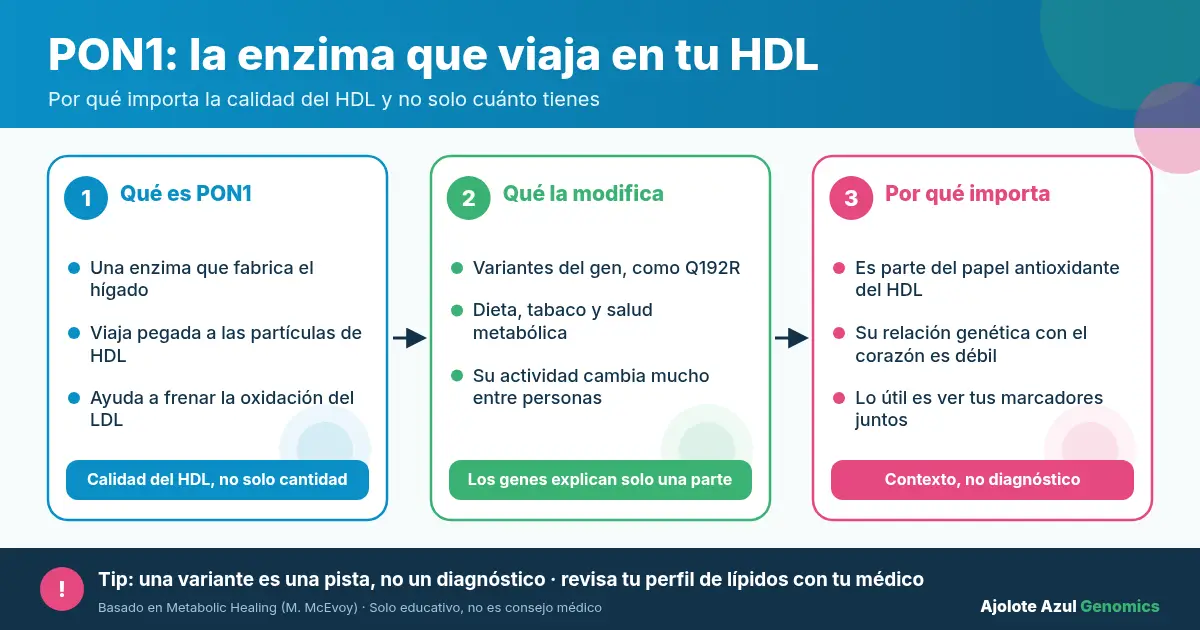
PON1 Gene: Function, HDL, and the Q192R Variant
What does the PON1 gene do? How it relates to paraoxonase, HDL cholesterol, and the Q192R variant—what the evidence shows and its limits.
7 min readRead more
Wellness
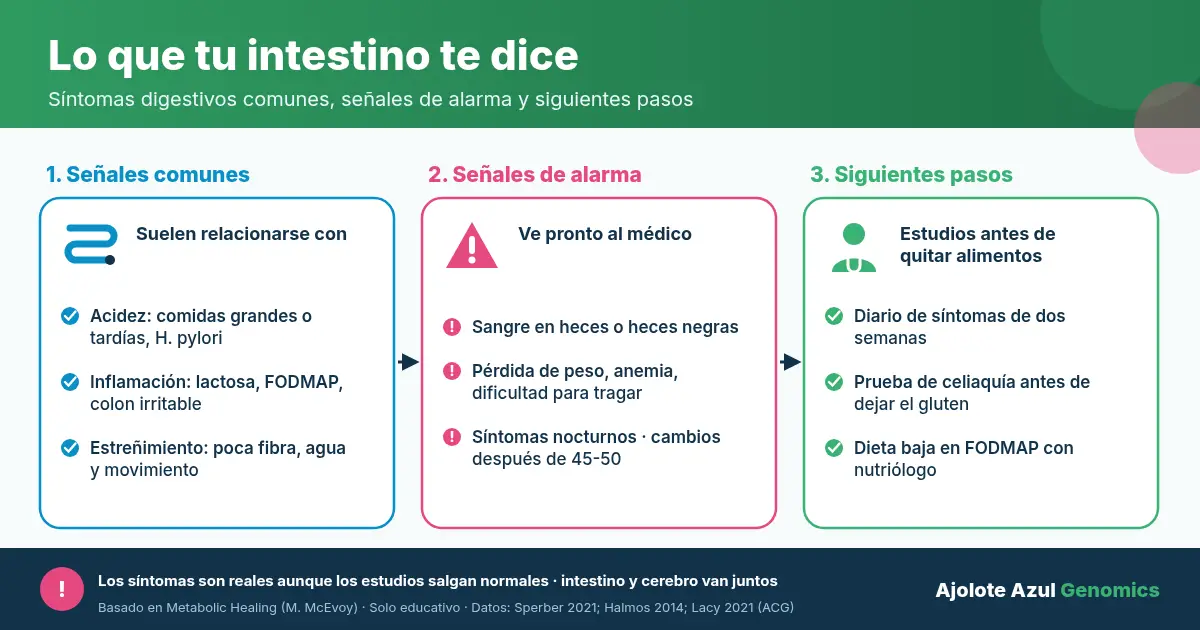
Digestive Symptoms: What Your Gut Is Telling You
Bloating, heartburn, or constipation can have several causes. Learn the warning signs and how a genetic test looks at lactose, gluten, and B12.
8 min readRead more
Wellness
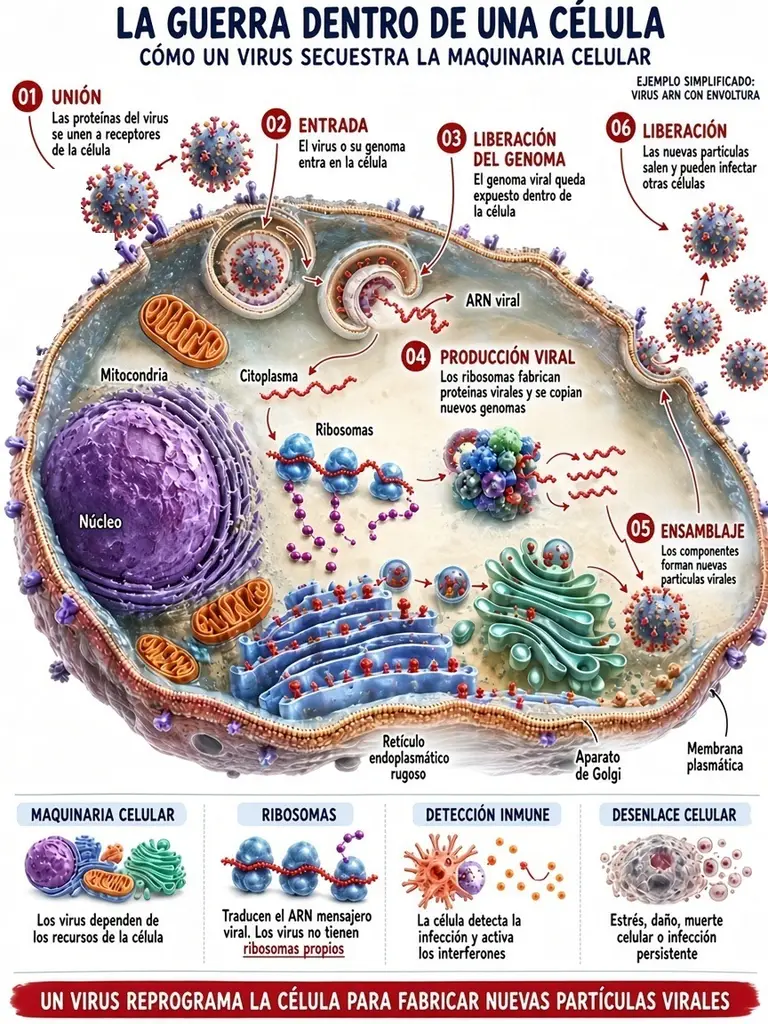
How a Virus Infects a Cell and How the Body Defends
Step by step: how a virus hijacks a cell to multiply, and the defenses your body uses—interferons, sensors, and apoptosis.
5 min readRead more
Did you like this article?
Discover how you can optimize your health with a personalized nutrigenetic test