Back to blog
Wellness
Choline and estrogens: why a woman's choline needs change with her hormones and her genes
7 min read
Ajolote Azul Team
choline
estrogens
PEMT gene
menopause
methylation
nutrigenetics
Based on the work of our partners at Metabolic Healing (Michael McEvoy). Read the original article: Estrogen & Phosphatidylcholine: Are You Deficient?
Choline almost never makes the news, but your liver, your brain, and your muscles use it every day. And it has one particular feature: how much you need from food depends partly on your hormones and partly on your genes. In women, that means the requirement can change after menopause.
Here is how estrogens, a liver gene called PEMT, and what you eat fit together.
What is choline, and why do you need it?
Choline is an essential nutrient, a close relative of the B-complex vitamins. The body uses it to make:
- Phosphatidylcholine, a main component of cell membranes and of the particles that carry fat out of the liver.
- Acetylcholine, a messenger used by nerves and muscles.
- Betaine, which donates methyl groups to the same methylation cycle that depends on folate.
When the liver is short of choline, it struggles to export fat, and that fat can build up there. Even so, most people eat less than recommended. In a large nutrition survey in the United States, only about 11% of people met the adequate intake (AI) for choline, and just 6% of women 1. México does not have an equivalent national figure, but a diet with little egg, fish, or liver can also fall short.
Your body makes some choline, with help from estrogens
You do not depend only on your plate. The liver can produce phosphatidylcholine on its own thanks to an enzyme encoded by the PEMT gene.
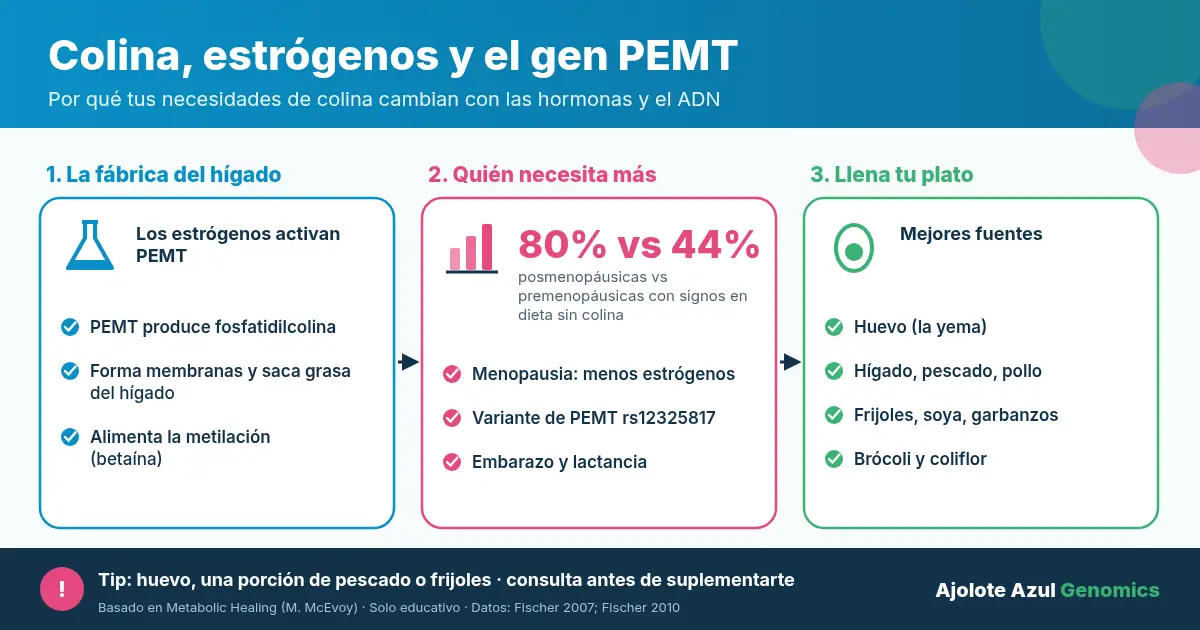
PEMT responds to estrogens. In human and mouse liver cells, estradiol increased PEMT activity in proportion to the dose, and the researchers found estrogen-response sequences in the region that controls the gene 2. That helps explain something seen in practice: women of reproductive age usually withstand a low-choline diet better.
What happened when people ate very little choline
Researchers put it to the test. Fifty-seven healthy adults followed a diet with a normal amount of choline and then another with almost no choline for up to six weeks, under medical supervision. Signs of fatty liver or muscle damage appeared in:
- 77% of the men
- 80% of postmenopausal women
- 44% of premenopausal women 3
Everyone recovered when choline was given again. It is striking that six men showed those signs even while eating the recommended amount, a reminder that one figure does not fit everyone 3.
Does your DNA change how much choline you need? Ajolote Azul's NGx nutrigenetic test reviews 70 markers of vitamins, folate (MTHFR), lipid metabolism, and more, and includes a 1-to-1 consultation to turn them into an eating plan. The panel includes PEMT and MTHFD1, the choline genes your report reviews. Questions? Book a free 15-minute call.
The PEMT gene: why some women need more
Estrogens do not explain everything. A common variant in the promoter of the PEMT gene, rs12325817, seems to blunt its response. In the same depletion study, 78% of people who carried the C allele developed abnormalities on the low-choline diet 4.
A later trial, in women only, found a very clear pattern according to the number of copies 5:
| Group | Showed signs of organ dysfunction |
|---|---|
| Premenopausal, 2 copies of the variant | 80% |
| Premenopausal, 1 copy | 43% |
| Premenopausal, no copies | 13% |
| Postmenopausal, placebo | 73% |
| Postmenopausal, estrogen | 18% |
In short: a premenopausal woman with two copies of the variant can, in nutritional terms, behave more like a postmenopausal woman. And after menopause, as estrogens fall, most women need more choline.
Important: these were short, supervised research diets, designed to provoke a deficiency. They do not mean someone should take hormones to "fix" choline, and they are not a way to diagnose liver disease. What they do show is that some people have to look after the choline in their diet with more intention.
Where to find choline in Mexican food
Animal foods are the richest sources, though plant foods add some too:
- Egg. The yolk is one of the best everyday sources. Mexican-style eggs count.
- Liver and other organ meats, such as beef or chicken liver, in small portions.
- Fish and shellfish: sardines, tuna, salmon, shrimp.
- Chicken, beef, and pork.
- Beans, soy, and chickpeas. Useful if you are vegetarian, though less concentrated.
- Broccoli, cauliflower, Brussels sprouts, and quinoa, in smaller amounts.
If you are vegetarian or vegan, you are postmenopausal, or you are pregnant or breastfeeding, choline deserves more attention. Pregnancy and breastfeeding raise the requirement because the baby's brain needs it. Many prenatal vitamins contain little choline or none, so ask your doctor.
Choline, folate, and methylation
Choline and folate share the work of the methylation cycle. When folate is lacking or the MTHFR route runs slowly, the body leans more on choline (through betaine), and the reverse is also true. That is why nutrigenetic reports look at these nutrients together, not one by one.
Is a choline supplement worth taking?
Food is the best place to start. Supplements such as phosphatidylcholine or choline bitartrate exist, but very high doses can cause a fishy body odor, digestive discomfort, or low blood pressure, and the right amount depends on your diet and your situation. Check with a health professional before you start, especially if you have a liver disease or you take medications.
Frequently asked questions
Do estrogens influence choline?
Yes. Estrogens activate the PEMT gene in the liver, which produces phosphatidylcholine. That is one reason why, in the studies, premenopausal women tolerated low-choline diets better than men or postmenopausal women.
Do women need more choline after menopause?
The studies point to yes. In a controlled trial, 73% of postmenopausal women on placebo showed signs of dysfunction on a very low-choline diet, compared with 18% of those who received estrogen. Eating enough choline-rich foods becomes more important at this stage.
What is the rs12325817 variant of the PEMT gene?
It is a common variant in the promoter of the PEMT gene that seems to reduce how well the gene responds. People who carry it developed signs of choline deficiency more often on low-choline research diets.
Which foods have the most choline?
Egg yolk, liver, fish, and other meats are the richest sources. Beans, soy, chickpeas, and cruciferous vegetables contribute smaller amounts.
Turn your genes into a practical plan
- NGx nutrigenetic test: 70 markers of nutrition, vitamins, intolerances, metabolism, and more, with a 1-to-1 consultation included. $9,880 MXN.
- PGx pharmacogenetic test: how you process more than 200 medications. $9,800 MXN.
- NGx + PGx combo: $15,750 MXN. See the tests · Book your free 15-min call · Message us on WhatsApp
References
- Wallace TC, Fulgoni VL 3rd. Assessment of Total Choline Intakes in the United States. J Am Coll Nutr. 2016;35(2):108-112. doi:10.1080/07315724.2015.1080127. PubMed 26886842 · doi:10.1080/07315724.2015.1080127
- Resseguie M, Song J, Niculescu MD, da Costa KA, Randall TA, Zeisel SH. Phosphatidylethanolamine N-methyltransferase (PEMT) gene expression is induced by estrogen in human and mouse primary hepatocytes. FASEB J. 2007;21(10):2622-2632. doi:10.1096/fj.07-8227com. PubMed 17456783 · Free full text (PMC) · doi:10.1096/fj.07-8227com
- Fischer LM, daCosta KA, Kwock L, et al. Sex and menopausal status influence human dietary requirements for the nutrient choline. Am J Clin Nutr. 2007;85(5):1275-1285. doi:10.1093/ajcn/85.5.1275. PubMed 17490963 · Free full text (PMC) · doi:10.1093/ajcn/85.5.1275
- da Costa KA, Kozyreva OG, Song J, Galanko JA, Fischer LM, Zeisel SH. Common genetic polymorphisms affect the human requirement for the nutrient choline. FASEB J. 2006;20(9):1336-1344. doi:10.1096/fj.06-5734com. PubMed 16816108 · Free full text (PMC) · doi:10.1096/fj.06-5734com
- Fischer LM, da Costa KA, Kwock L, Galanko J, Zeisel SH. Dietary choline requirements of women: effects of estrogen and genetic variation. Am J Clin Nutr. 2010;92(5):1113-1119. doi:10.3945/ajcn.2010.30064. PubMed 20861172 · Free full text (PMC) · doi:10.3945/ajcn.2010.30064
This article is for information and education only; it does not replace consultation, diagnosis, or treatment by a health professional. Talk with your doctor before changing your diet, your medications, or your supplements.
Based on the work of our partners at Metabolic Healing (Michael McEvoy). Read the original article: Metabolic Healing
A
Ajolote Azul Team
Specialist in wellness, nutrition and holistic health. Passionate about sharing science-based knowledge to improve quality of life.
Keep Reading
Related Articles
Discover more content on this topic that might interest you
Wellness
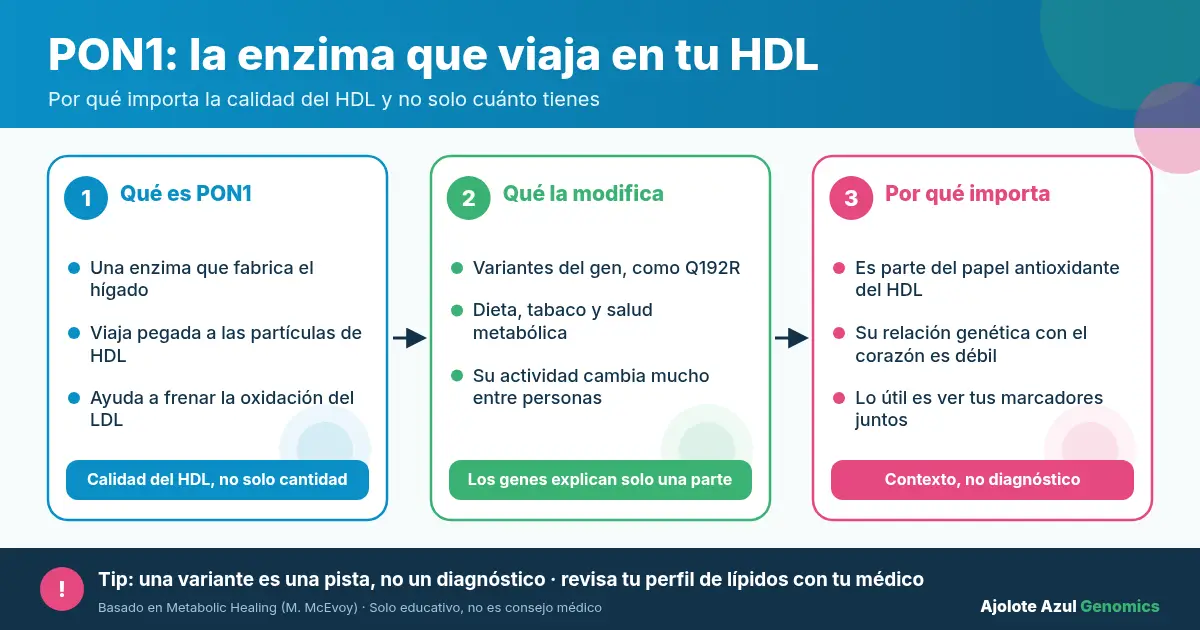
PON1 Gene: Function, HDL, and the Q192R Variant
What does the PON1 gene do? How it relates to paraoxonase, HDL cholesterol, and the Q192R variant—what the evidence shows and its limits.
7 min readRead more
Wellness
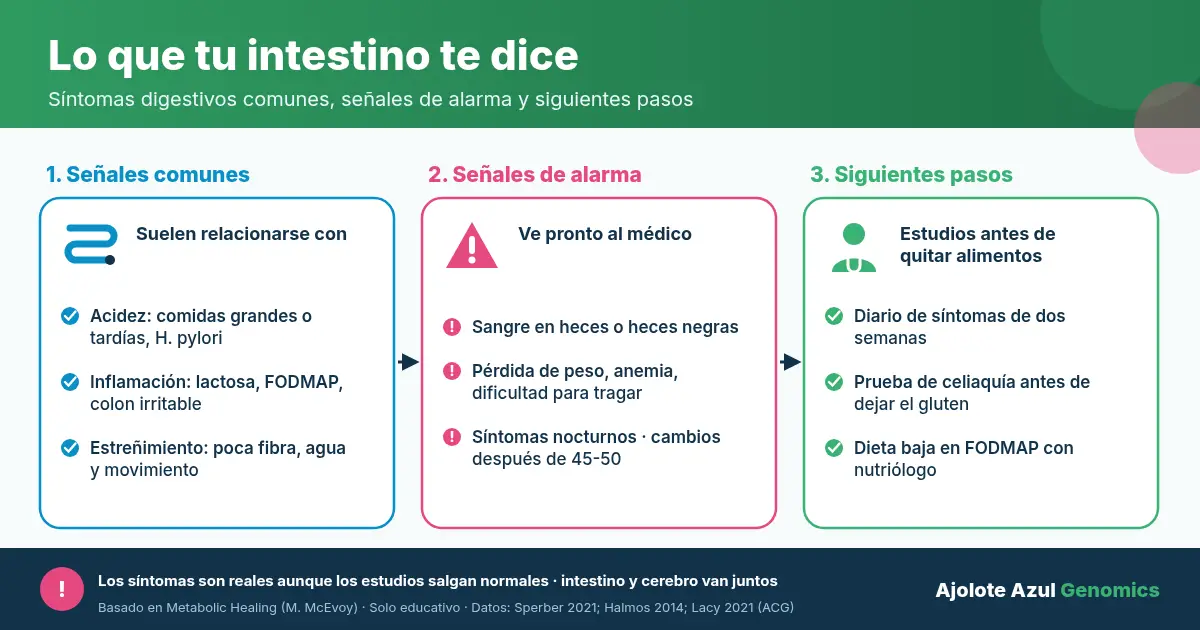
Digestive Symptoms: What Your Gut Is Telling You
Bloating, heartburn, or constipation can have several causes. Learn the warning signs and how a genetic test looks at lactose, gluten, and B12.
8 min readRead more
Wellness
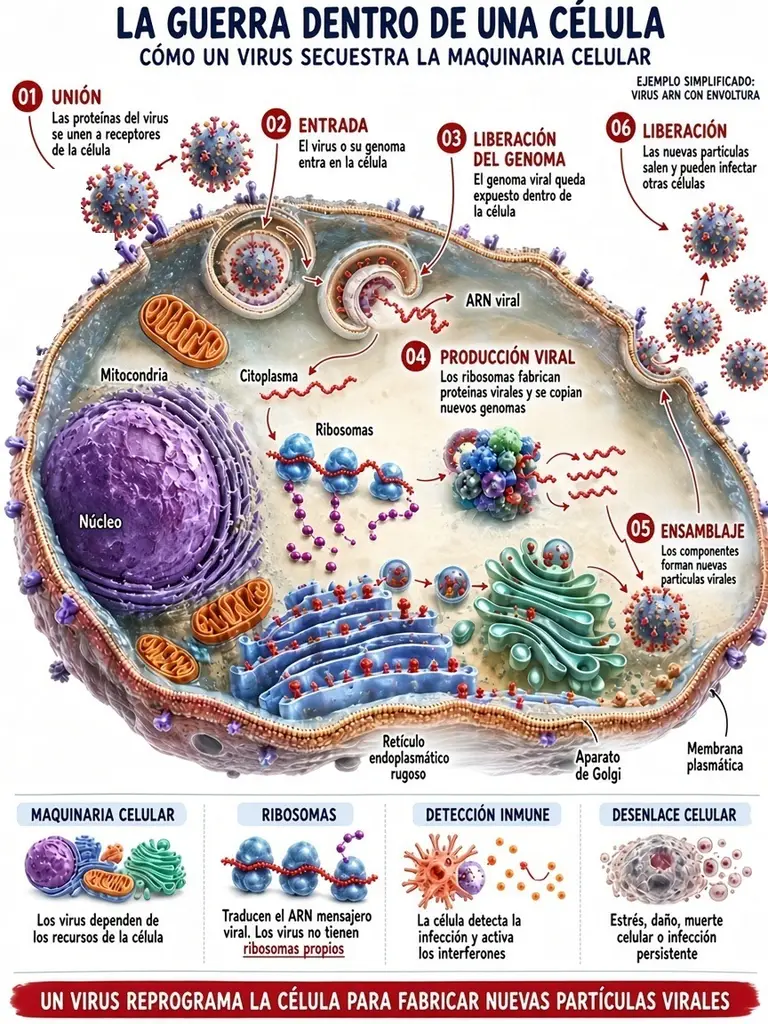
How a Virus Infects a Cell and How the Body Defends
Step by step: how a virus hijacks a cell to multiply, and the defenses your body uses—interferons, sensors, and apoptosis.
5 min readRead more
Did you like this article?
Discover how you can optimize your health with a personalized nutrigenetic test