Back to blog
Nutrigenetics
Lactobacillus reuteri: What This Probiotic Can and Cannot Do, According to Evidence
7 min read
Ajolote Azul Team
Lactobacillus reuteri
probiotics
infant colic
H. pylori
gut microbiome
nutrigenetics
Based on the work of our Metabolic Healing partners (Michael McEvoy). Read the original article: Lactobacillus Reuteri: Autoimmune & Your Gut Microbiome
Walk down any supplement aisle and you will see Lactobacillus reuteri on more and more labels. It is one of the most studied probiotic species worldwide and has a reputation for doing everything from soothing colicky babies to “balancing” the immune system.
Some of that reputation is well earned. Some still rests on mouse experiments. Here we separate the two so you can talk with your doctor with realistic expectations.
What is L. reuteri?
L. reuteri (now officially Limosilactobacillus reuteri, though most labels still use the older name) is a lactic acid bacterium that naturally lives in the human gut and has been found in breast milk. It is known mainly for making substances that make life harder for some unwanted microbes and for interacting with immune cells in the intestinal wall.
One key point before going on: a probiotic’s effect depends on the strain. “L. reuteri DSM17938” and “L. reuteri RC-14” are different strains, and what is shown with one cannot be assumed for the other. Good studies—and good labels—list the strain.
Where evidence is strongest: infant colic
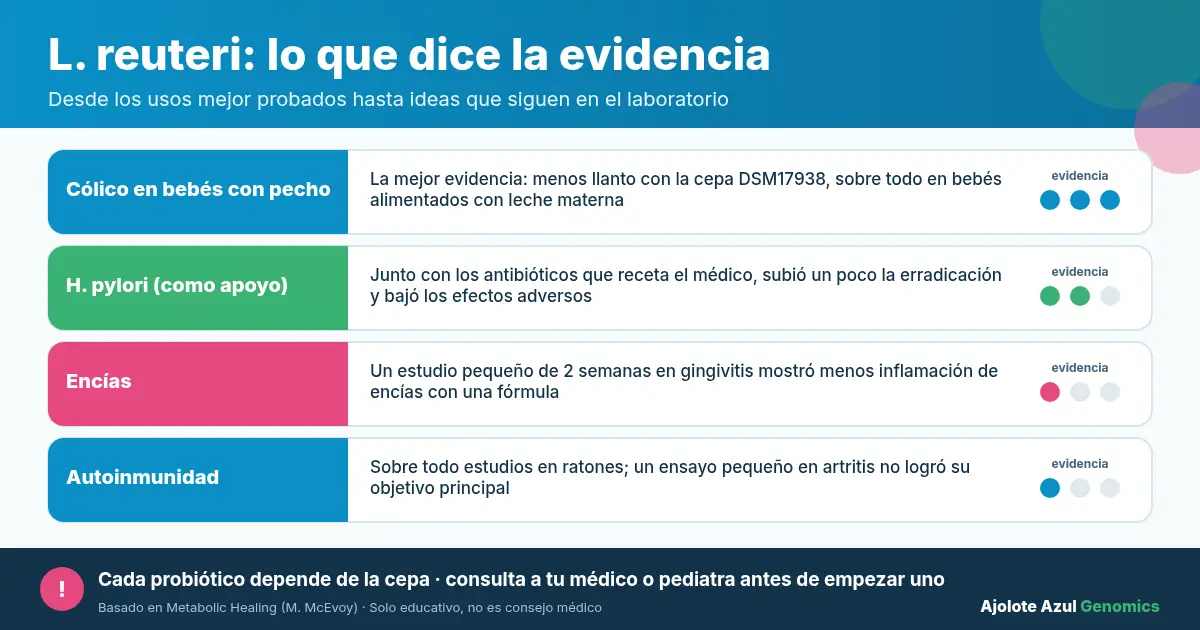
The best-studied use is colic in infants. A meta-analysis pooled individual data from 345 babies in four double-blind trials of strain DSM17938. Babies who got the probiotic cried or fussed about 25 minutes less per day at three weeks compared with placebo. The benefit was large in breastfed babies but was not significant in those on formula 1.
If you are a parent, this is a conversation with your pediatrician: they can rule out other causes of crying and guide you on products and doses.
H. pylori: support, not a substitute
H. pylori is a stomach bacterium that can cause gastritis and ulcers. Doctors treat it with a mix of antibiotics and acid-lowering drugs. A meta-analysis of eight randomized trials (1,087 patients) found that adding L. reuteri to that treatment raised eradication from about 73% to 80% and cut adverse effects such as diarrhea and nausea 2.
Note the role it played: L. reuteri was tested on top of standard therapy. It has not been shown to clear H. pylori on its own, so it does not replace the treatment your doctor prescribes.
Gum health
The mouth has its own microbiota. In a small two-week trial, 59 adults with moderate to severe gingivitis used a L. reuteri product or placebo plus brushing and flossing instructions. One of the two formulas reduced gum inflammation more than placebo, and both reduced plaque 3. It is promising but small. Brushing, flossing, and dental checkups remain the foundation.
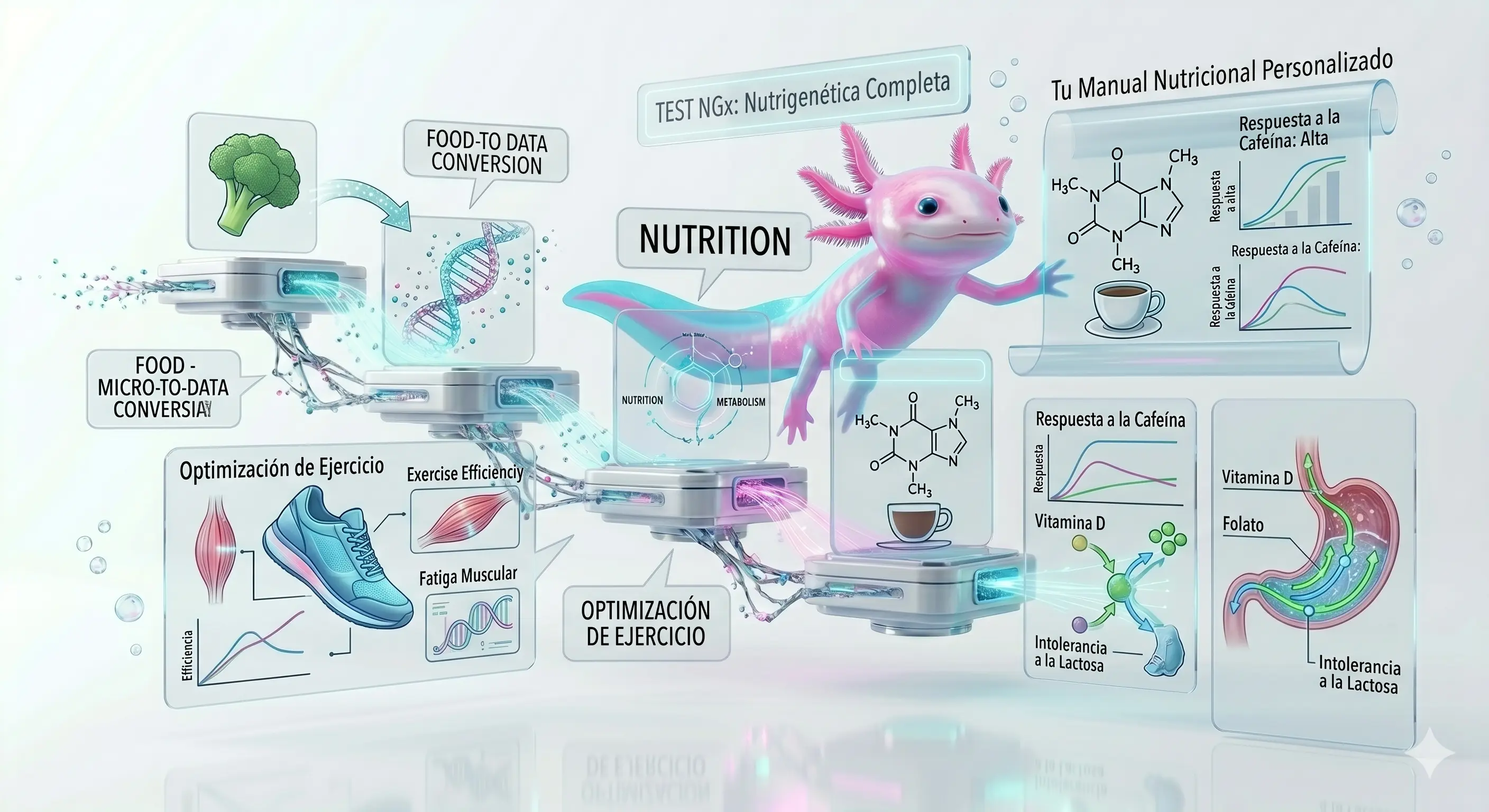
Your gut and your genes talk to each other The NGx nutrigenetic test from Ajolote Azul analyzes more than 70 markers, including genetic lactose intolerance, histamine and gluten sensitivity, and includes a 1:1 consult to turn results into food choices. Questions first? Book a free 15-minute orientation call.
Autoimmunity: interesting but preliminary
Much of the excitement about L. reuteri and autoimmune disease comes from animal studies. One example is “scurfy” mice, which lack regulatory T cells (Tregs) that normally stop the immune system from attacking the body. In these mice, strain DSM17938 extended survival and reduced inflammation in several organs, and the effect depended on an adenosine receptor 4.
That is a valuable clue for researchers, but what happens in mice often does not repeat in people. In a small pilot trial, 29 adults with active rheumatoid arthritis took a two-strain probiotic (L. rhamnosus GR-1 plus L. reuteri RC-14) or placebo for three months. The probiotic did not improve the main measure of arthritis activity versus placebo. A daily function questionnaire improved within the probiotic group, but the between-group difference was not significant 5.
Honestly: there is still no solid evidence that L. reuteri treats lupus, multiple sclerosis, rheumatoid arthritis, or other autoimmune diseases. If you live with one, follow the treatment plan you agreed on with your specialist.
Feeding your bacteria without capsules
Probiotic capsules are only one tool. The bacteria already in your gut depend on what you eat:
- Fiber and variety. Beans, lentils, nopales (cactus pads), oats, chayote, vegetables, and fruit feed many species.
- Fermented foods, if they sit well with you: plain yogurt, kefir, sauerkraut, or traditional drinks like tepache in moderation (it contains sugar).
- Fewer ultra-processed foods. Diets low in fiber and high in additives associate with a less diverse microbiota.
- Antibiotics only when needed, and always as prescribed.
Some people react badly to certain foods because of their genes, not their bacteria. Lactose intolerance is the classic example. Knowing which case is yours saves a lot of trial and error.
Frequently asked questions
What is Lactobacillus reuteri good for?
The strongest evidence is for colic in breastfed infants (DSM17938 strain) and as support alongside medical treatment for H. pylori. Gum results are promising but small, and autoimmune uses are still mostly animal research.
Can I take L. reuteri every day?
Probiotics are usually well tolerated in healthy adults. People who are immunocompromised, seriously ill, or have a central line should ask their doctor first. Choose a product that lists the strain.
Does L. reuteri help autoimmune disease?
Not proven. Rat studies are interesting, but a small rheumatoid arthritis trial did not find better disease activity than placebo.
Are all L. reuteri products the same?
No. The effect depends on the strain, so look for the strain code on the label (for example, DSM17938) and compare it with the studies.
Turn your genes into a practical plan
- NGx nutrigenetic test: more than 70 nutrition, vitamin, intolerance, and antioxidant markers, with a 1:1 consult included. $9,880 MXN.
- PGx pharmacogenetic test: how you process more than 100 medications. $9,800 MXN.
- NGx + PGx Combo: $15,750 MXN. Learn about the NGx test · Book your free 15-min call · WhatsApp us
References
- Sung V, D'Amico F, Cabana MD, et al. Lactobacillus reuteri to Treat Infant Colic: A Meta-analysis. Pediatrics. 2018;141(1). doi:10.1542/peds.2017-1811. PubMed 29279326 · doi:10.1542/peds.2017-1811
- Li M, Wang X, Dong X, Teng G, Dai Y, Wang W. Lactobacillus reuteri compared with placebo as an adjuvant in Helicobacter pylori eradication therapy: a meta-analysis of randomized controlled trials. Ther Adv Gastroenterol. 2024;17:17562848241258021. doi:10.1177/17562848241258021. PubMed 38846173 · Free full text (PMC) · doi:10.1177/17562848241258021
- Krasse P, Carlsson B, Dahl C, Paulsson A, Nilsson A, Sinkiewicz G. Decreased gum bleeding and reduced gingivitis by the probiotic Lactobacillus reuteri. Swed Dent J. 2006;30(2):55-60. PubMed 16878680
- He B, Hoang TK, Tran DQ, Rhoads JM, Liu Y. Adenosine A(2A) Receptor Deletion Blocks the Beneficial Effects of Lactobacillus reuteri in Regulatory T-Deficient Scurfy Mice. Front Immunol. 2017;8:1680. doi:10.3389/fimmu.2017.01680. PubMed 29270168 · Free full text (PMC) · doi:10.3389/fimmu.2017.01680
- Pineda Mde L, Thompson SF, Summers K, de Leon F, Pope J, Reid G. A randomized, double-blinded, placebo-controlled pilot study of probiotics in active rheumatoid arthritis. Med Sci Monit. 2011;17(6):CR347-54. doi:10.12659/msm.881808. PubMed 21629190 · Free full text (PMC) · doi:10.12659/msm.881808
This article is for education and information only; it does not replace medical advice, diagnosis, or treatment. Talk to your doctor before changing your diet, medications, or supplements.
Based on the work of our Metabolic Healing partners (Michael McEvoy). Read the original article: https://metabolichealing.com/lactobacillus-reuteri-autoimmune-your-gut-microbiome
A
Ajolote Azul Team
Specialist in wellness, nutrition and holistic health. Passionate about sharing science-based knowledge to improve quality of life.
Keep Reading
Related Articles
Discover more content on this topic that might interest you

Nutrigenetics
Genetics and Personalized Nutrition: How Are They Connected?
Explore the relationship between genetics and personalized nutrition, and how your DNA can guide more precise, effective eating habits.
5 min readRead more

Nutrigenetics
What Is Nutrigenetics Used For?
Learn what nutrigenetics is used for, how it relates to your DNA and how it can guide truly personalized nutrition decisions.
5 min readRead more
Nutrigenetics
Nutrition Genetic Test in Mexico
Discover what a nutrition genetic test in Mexico analyzes and how it can help you understand your metabolism, your nutrients and your eating habits.
4 min readRead more
Did you like this article?
Discover how you can optimize your health with a personalized nutrigenetic test